


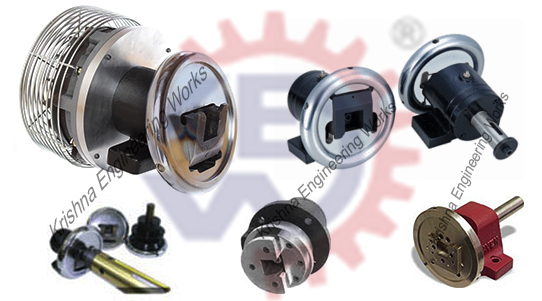
Safety Chucks (Locking Assembly) for Square Winding Shafts
Safety chucks are bearing mounted holders that carry the square ends of a winding shaft, transmit the torque, and open by a hinged jaw so the shaft can be lifted out without tools. Krishna Engineering Works manufactures safety chucks, also called a locking assembly, for 25, 32, 38, 40, 75 and 90 mm square shafts, and for other sizes on request.
The chucks are made in Ahmedabad, India, as heavy duty units for slitter rewinders and other winding machines. This page explains how they work, how to select and mount them, and what to send for a quotation.
What are safety chucks and how do they work?
Safety chucks are a pair of rotating sockets, one on each side frame, that hold a shaft by its square journals. Each chuck has a spindle that runs in bearings and a head with a square pocket. Half of that pocket is a hinged or sliding jaw.
The working cycle is simple. With the opening upward, the operator swings the jaw open by its handwheel, lowers the shaft into the pocket and closes the jaw. As soon as the chuck turns away from the loading position, the jaw is held shut by the shape of the housing. It cannot open while the shaft is running, and that is the safety in the name.
The square seat does two jobs at once. It locates the shaft, and it transmits torque without a key or a coupling. A reel change therefore takes one lift in and one lift out, with no bolts to undo.
A locking assembly has these main parts:
- Housing. The body that bolts to the machine and holds the bearings.
- Spindle. The rotating shaft, with an extension for a brake, a clutch or a drive.
- Head with square pocket. The seat for the shaft journal.
- Tilting jaw and handwheel. The part that opens for loading and locks in rotation.
- Bearings. Rolling-element bearings that carry the reel weight.
Safety chuck sizes made by Krishna Engineering Works
Krishna Engineering Works makes the locking assembly in six standard sizes, named by the square of the shaft journal they accept:
- For 25 mm square shaft
- For 32 mm square shaft
- For 38 mm square shaft
- For 40 mm square shaft
- For 75 mm square shaft
- For 90 mm square shaft
Other sizes are made to the customer’s requirement. KEW builds the chucks as heavy duty units for high speed and high torque applications, and matches them to the length and journal of the air shaft they will carry.
The square size is only the starting point. A larger square carries more torque and belongs to a heavier shaft, so the size follows from the reel weight, the web tension and the reel diameter. Send those figures and the square is confirmed with the shaft design.
Foot mounted or flange mounted?
A foot mounted chuck bolts down onto a flat surface, and a flange mounted chuck bolts onto the face of a side frame. These are the two mounting styles in general use across the industry, and the choice depends on the machine frame, not on the reel.
| Point | Foot mounted | Flange mounted |
| Fixing surface | Horizontal: base plate, pedestal or stand | Vertical: side frame or wall plate |
| Typical machine | Unwind and rewind stands, shaft trolleys, retrofits | Slitter rewinders, printing and laminating machines with plate frames |
| Space needed | Floor or ledge beside the reel | A bore or clear face on the frame |
| Height setting | Shims under the feet | Fixed by the bore position |
| Change of position later | Easy, by re-drilling the base | Needs a new bore in the frame |
When you enquire, state which style the machine needs and give the fixing dimensions, so the housing is made to suit.
Drive side and brake side
A pair of chucks is rarely identical. One side normally carries the device that controls the reel, and the other side only supports the shaft.
- Brake side. At an unwind, the spindle extension carries a brake that holds the web tension. This is usually a pneumatic brake or powder brake.
- Drive side. At a rewind, the extension carries a clutch, a pulley or a geared motor that turns the reel.
- Plain side. The opposite chuck has a short spindle and simply runs in its bearings.
- Side shift. Where the reel has to be centred or guided, one or both chucks may be made to slide.
The brake or clutch is often driven from a tension control unit, so the chuck spindle has to match the bore and the key of that device. Give the make and bore in the enquiry.
How to select safety chucks
Select the chucks from the shaft and the duty, in this order.
- Note the square size of the existing shaft journals, or decide it with the new shaft.
- Add the maximum reel weight to the shaft weight. Each chuck carries about half.
- Work out the highest torque: web tension multiplied by the largest reel radius, plus any acceleration.
- Note the maximum shaft speed, which occurs at the smallest reel diameter and the highest line speed.
- Choose foot or flange mounting from the machine frame.
- Decide which side takes the brake, clutch or drive, and note its bore and key.
- Give the distance between the frames, so the shaft length and the chuck positions agree.
| Your situation | What to specify |
| Replacing worn chucks on an existing machine | Square size, mounting style, fixing hole pattern, spindle extension |
| New unwind stand with a tension brake | Square size, reel weight, brake make and bore |
| Rewind with a driven shaft | Square size, torque at full reel, drive connection |
| Several shaft lengths on one machine | The range of shaft lengths and one common square size |
| Shaft with round journals | A square size to machine onto the journals, or new journals |
Fitting and alignment
Chucks must be fitted on one common centre line, at the same height, and square to the web path. If they are not, the shaft is forced to bend on every turn, and both the square seats and the bearings wear quickly.
General good practice is this.
- Set both chucks with a straight test bar or the actual shaft in place, then tighten the fixing bolts.
- Leave a small axial clearance for the shaft, so heat growth does not load the bearings.
- Check that both jaws open at the same angular position, so the shaft drops in without twisting.
- Turn the loaded shaft by hand once before the first run and listen for tight spots.
- Fit guards over the rotating heads and handwheels, as for any rotating part.
Care and common faults
Safety chucks need little attention, but the square seats are wearing parts. A regular look at the seats and a little grease are usually enough.
| Symptom | Likely cause | First check |
| Knocking as the reel turns | Square seat or shaft journal worn | Play between journal and pocket |
| Jaw hard to open or close | Dirt or dried grease in the hinge | Clean and lubricate the hinge |
| Jaw does not stay shut | Locking faces worn or damaged | Stop the machine and replace the worn parts |
| Housing runs hot | Bearing failing, or shaft has no axial clearance | Bearing noise, end float of the shaft |
| Tension pulses once per turn | Chucks out of line, or shaft bent | Alignment and shaft run out |
| Shaft end damaged at loading | Shaft lowered with the jaw half open | Loading practice, hoist control |
Many chucks are made with replaceable seat inserts, so wear can be corrected without a new housing. Never run a chuck whose jaw does not lock. For repair work, see repairing and servicing.
Where safety chucks are used
Safety chucks are used at every unwind and rewind where a shaft is lifted in and out of the machine. In converting that means slitter rewinders, printing machines, laminators, coaters and winders.
KEW names the slitter rewinder machine as the main application. The same chucks suit a rewinder unwinder station built for another line, and the unwind of a doctoring rewinding machine. They carry air shafts as well as the mechanical designs on the expandable shaft page.
The group’s specialist site on air shafts and chucks compares shaft and chuck designs in more depth. The whole catalogue is on the products page.
What to send for a safety chuck quotation
Safety chucks are matched to your shaft and your frame. Send:
- Square size of the shaft journal: 25, 32, 38, 40, 75 or 90 mm, or the size you need
- Mounting style and the fixing dimensions
- Maximum reel weight, reel diameter and web width
- Maximum web tension and line speed
- Position: unwind or rewind
- Brake, clutch or drive to be fitted, with its bore and key
- Distance between the machine frames and the shaft length
- Quantity, in pairs or as single pieces
Send these through the contact page.
Frequently Asked Questions
What is a safety chuck used for?
A safety chuck is used to hold a winding shaft at an unwind or rewind station. It supports the square end of the shaft in bearings, transmits the braking or driving torque, and opens so the shaft can be lifted out. This makes reel changes quick and removes the need for couplings or loose bearing caps.
Which safety chuck sizes does Krishna Engineering Works make?
Krishna Engineering Works makes safety chucks for 25 mm, 32 mm, 38 mm, 40 mm, 75 mm and 90 mm square shafts. Other sizes are made to the customer’s requirement. The size refers to the square journal of the shaft that sits in the chuck pocket.
Why is it called a safety chuck?
It is called a safety chuck because the jaw that holds the shaft cannot open while the chuck is turning. The jaw is free only in the loading position, with the opening upward. Once the chuck rotates, the housing keeps the jaw closed, so the shaft and the reel stay captive in the machine.
What is the difference between foot mounted and flange mounted safety chucks?
A foot mounted safety chuck bolts down onto a horizontal surface such as a base plate or a pedestal. A flange mounted safety chuck bolts onto the vertical face of a side frame. The working parts are the same. The choice depends only on how the machine frame is built and where there is room.
Can a brake be fitted to a safety chuck?
Yes, a brake can be fitted to a safety chuck. The spindle of one chuck is extended so that a pneumatic brake, a powder brake or a clutch can be mounted on it. At an unwind the brake controls the web tension. Give the bore and key of the brake when you order.
How do I choose the size of a safety chuck?
Choose the size from the square journal of the shaft, and choose the square from the load and the torque. Add the reel weight to the shaft weight, then work out the torque from the web tension and the largest reel radius. With these figures the square size is confirmed.
How often should safety chucks be checked?
Safety chucks should be looked at whenever the shaft is out, and inspected properly during planned maintenance. Check the square seats for wear, the jaw for free movement and firm locking, and the bearings for noise or heat. Replace worn seats early, because play in the square makes the reel knock and disturbs the web tension.

