

Slitter Rewinder Machine Manufacturer and Exporter
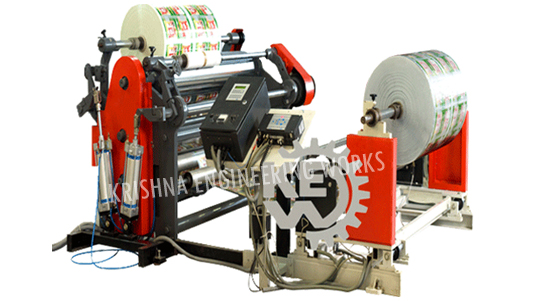
A slitter rewinder machine unwinds a wide parent reel, cuts the web lengthwise into narrower strips and rewinds each strip into a finished reel at controlled tension. The KEW slitter rewinder machine is a cantilever type built for working widths from 800 to 2000 mm and speeds up to 500 m/min, for film, foil, paper and laminates.
Krishna Engineering Works manufactures the machine in Ahmedabad, India, and configures it for the materials and reel sizes of each buyer. This page describes the construction, the specification and the choices to make before ordering.
What does a slitter rewinder machine do?
A slitter rewinder machine converts a jumbo reel into the reel widths and diameters that the next process or the end customer needs. Printing, lamination and coating are done at full web width because that is economical. Packing machines, label presses and tape lines need narrow reels. The slitter rewinder sits between the two.
The process is called roll slitting. The machine does three jobs at once, and the quality of the finished reel depends on all three.
- Unwinding. The parent reel is braked so the web leaves it at a steady tension, and guided so its edge stays on one line.
- Slitting. Knives cut the moving web into strips. Edge trim is removed at both sides.
- Rewinding. Each strip is wound on its own core, at its own tension, to the required diameter.
How the KEW cantilever slitter rewinder is built
The KEW machine is a cantilever type: the rewind shafts are supported at one end only, so finished reels slide off the open end without lifting a shaft out of the machine. This makes unloading quick and keeps the operator at one side.
The live specification of the machine lists these main systems:
- Three motor control system. Separate motors drive the web and the two rewind shafts, so each can follow its own speed and torque curve.
- Independent rewind tension control. Each rewind station controls its own tension, which gives accurate winding when the two shafts carry different reel widths.
- Non-contact ultrasonic diameter measurement. The machine reads the growing reel diameter without touching the reel and uses it to adjust winding tension as the reel builds.
- Core lock for differential slip. The rewind cores are held by locks that allow each core a small, controlled slip, so strips of slightly different thickness all wind tight.
- Unwind pneumatic brake and load cell feed brake. The unwind is braked pneumatically, and a load cell measures web tension so the brake can hold it constant from full reel to empty core.
- Digital edge or line guiding. The web is guided from its edge, or from a printed line, before it reaches the knives.
Heavy duty construction is used throughout, so the frames stay rigid at speed.
Edge guiding before the knives
Slit width accuracy starts at the unwind. If the parent reel is wound unevenly, the web wanders sideways and the trim width changes. An edge guide moves the unwind stand to keep the web edge, or a printed line, at a fixed position. KEW makes its own web guiding system, so the guide and the machine are matched.
Rewind shafts and cores
Rewind shafts must grip the cores firmly and release them fast. For duplex winding with many cores on one shaft, differential shafts let each core slip a little so all reels stay tight. The air shaft page lists the shaft types KEW makes for slitter rewinders, including differential and ball shafts.
Technical specification of the slitter rewinder machine
The table gives the specification of the KEW cantilever slitter rewinder as published by Krishna Engineering Works. Other sizes are built to order.
| Item | Specification |
| Machine type | Cantilever type slitter rewinder |
| Maximum working width | 800 to 2000 mm |
| Unwind diameter | 1000 mm |
| Rewind diameter | 500 mm |
| Minimum slitting width | 50 mm |
| Machine speed | 300 or 500 m/min |
| Drive | Three motor control system |
| Unwind tension | Pneumatic brake with load cell feedback |
| Rewind tension | Independent control for each rewind shaft |
| Diameter measurement | Non-contact ultrasonic |
| Guiding | Digital edge or line guiding |
The machine can be customised to suit international standards and special applications.
Which materials can a slitter rewinder machine slit?
The KEW slitter rewinder machine slits plastic films, foils, papers, laminates, tapes and textiles. Each material group behaves differently at the knife and at the rewind, so tell KEW which ones you run.
| Material | Examples | What matters when slitting |
| Plastic films | LDPE, BOPP, OPP, PET, METPET | Low and steady tension, clean edges, static control |
| Aluminium foil | Plain and laminated foil | Very low stretch, edges crack if the knife is dull |
| Paper and paperboard | Coated paper, ice cream cup paper, fax roll paper | Dust control and knife life |
| PVC and laminated films | Multi layer laminates | Even tension across layers of different stretch |
| Adhesive tape and film ribbon | Narrow reels | Narrow slit widths and core alignment |
| Textiles | Nylon, woven sack, non woven fabric | Fraying edges and soft, compressible reels |
Thin films such as BOPP are usually cut with razor blades, in air or in a grooved roll. Paper, board, foil laminates and thicker materials are usually cut with rotary shear knives, where a top and a bottom knife work like scissors. Hard, brittle or very thick webs may be crush cut against a hardened roll. KEW supplies the knives as well: see slitting cutters and knives.
How do you choose the right slitter rewinder?
Choose the machine from the finished reel backwards. The reel your customer needs sets the rewind diameter, core size, slit width and winding hardness, and those set the machine.
- List every material with its thickness range. The thinnest and the stiffest decide the tension range.
- Fix the maximum parent reel width, diameter and weight. These set the working width and the unwind stand.
- Fix the narrowest and widest slit width and the largest finished reel diameter.
- Decide the slitting method for each material: razor, shear or crush.
- Set the production speed you really need, not the highest possible. Short runs with many changeovers gain little from top speed.
- Decide how reels are loaded and unloaded, and what happens to the edge trim.
- List the options that reduce operator work for your job mix.
Three KEW machines cover most slitting duties. The table shows how they differ.
| Machine | Winding principle | Typical duty |
| Cantilever slitter rewinder (this page) | Centre winding on two cantilever shafts with independent tension | Films, foils, laminates and papers at high speed |
| Heavy duty drum type slitter rewinder | Centre cum surface winding against drums | Paper and board grades at wide widths and large reel diameters |
| BOPP slitter rewinder | Slitter rewinder configured for tape materials | BOPP tape, masking tape and other coated tapes |
For a comparison of machine types across the group’s range, see the specialist site on slitter rewinder machines by type.
Reel quality: what the machine controls
Good reels have straight edges, even hardness and no wrinkles, and the machine achieves this by controlling tension, nip and web spreading. Problems that show at the customer’s packing line usually start at one of these three.
Tension must fall slightly as the reel grows, so the outer layers do not crush the inner ones. This is called taper tension, and the ultrasonic diameter reading is what makes it automatic. Strips must also be kept apart after the knives, or neighbouring reels interlock at their edges. A bow roll between the knives and the rewind does this.
| Reel fault | Likely cause | First check |
| Telescoping reel | Tension too low at the core or too high at the outside | Taper tension setting |
| Reels locked together | No gap between strips after slitting | Spreading roll setting, shaft allocation |
| Hard and soft reels on one shaft | Thickness variation across the parent web | Differential shaft or core lock slip |
| Wavy or dusty edges | Worn knife or wrong knife overlap | Knife condition and setting |
| Slit width drifting | Web wandering at the unwind | Edge guide sensor position |
Related machines and equipment
A slitter rewinder rarely works alone. KEW builds the machines and parts around it, so a slitting section can come from one source.
- The winding rewinding machine with inkjet printer codes and corrects slit reels.
- The inspection rewinding machine checks printed reels before or after slitting.
- Tension control units and load cells can be fitted to existing machines.
- Nip and lay on rollers are part of the rubber roller range and can be re-covered when worn.
The full catalogue is on the products page.
Installation and service
Krishna Engineering Works runs a continuous trial on each machine before dispatch and invites the customer to the factory to see the trial. The machine is then installed and commissioned on site, with operator training, for customers in India and abroad.
Spare parts and technical support continue after commissioning. Knives, shaft parts and rollers are the usual wear items. The repairing and servicing page gives the scope.
What to send for a slitter rewinder quotation
A slitter rewinder is quoted from your reel data. Send the following and KEW will propose the configuration:
- Materials, with thickness or GSM range for each
- Parent reel: maximum width, diameter, weight and core size
- Finished reels: slit widths, maximum diameter and core size
- Production speed required
- Slitting method preferred, if known
- Options needed, such as trim handling, shaft type or line guiding from a printed mark
- Power supply and available floor space
Send these through the contact page.
Frequently Asked Questions
What does a slitter rewinder machine do with a wide reel?
A slitter rewinder machine is used to cut a wide reel of film, foil, paper, laminate or fabric into narrower reels and wind them to the diameter the next process needs. It unwinds the parent reel under controlled tension, slits it with knives, and rewinds each strip on its own core. Converters use it after printing, lamination or coating.
What is the maximum speed and width of the KEW slitter rewinder?
The KEW cantilever slitter rewinder is offered with a maximum working width from 800 to 2000 mm and a machine speed of 300 or 500 m/min, as stated in its published specification. The unwind diameter is 1000 mm, the rewind diameter 500 mm and the minimum slitting width 50 mm. Other sizes are built to order.
What is the difference between a cantilever and a drum type slitter rewinder?
A cantilever slitter rewinder winds each reel from its centre on a shaft supported at one end, with tension controlled by the shaft drive. A drum type machine presses the reels against driven drums, so winding is partly by surface contact. Cantilever machines suit films and laminates at speed. Drum machines suit paper and board at large diameters.
Which slitting method is right for my material?
Razor slitting suits thin plastic films, because a blade parts the film with little force. Shear slitting with rotary top and bottom knives suits paper, board, foil laminates and thicker films. Crush slitting against a hardened roll is used for some non wovens and adhesive materials. The material thickness and stiffness decide the method.
Why does the machine measure reel diameter with ultrasound?
The machine measures reel diameter so that winding tension can be reduced gradually as the reel grows. An ultrasonic sensor does this without touching the reel, so it leaves no mark on soft or glossy material and has no arm or wheel to wear. The reading feeds the tension control of each rewind shaft.
What must a slitter rewinder have to run both film and paper?
To run both film and paper, a slitter rewinder needs a tension range that covers the thinnest film and the heaviest paper, and a knife section that accepts razor blades and shear knives. Tell KEW every material you plan to run, with its thickness range, so the machine is built for the full range.
Does Krishna Engineering Works make small slitter rewinder machines?
Yes, Krishna Engineering Works builds slitter rewinders to the buyer’s width and reel size, including smaller machines for narrow webs and lower output. For tapes and narrow film reels the BOPP slitter rewinder is the usual choice. Send the parent reel width and the finished reel sizes, and the machine is proposed to suit.

