


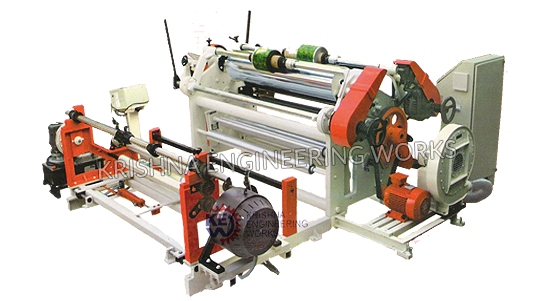
Heavy Duty Drum Type Slitter Rewinder Machine
A drum type slitter rewinder slits a wide parent reel into narrower reels and winds them while they rest against driven drums, so the drum surface helps turn the reel. The KEW heavy duty drum type slitter rewinder is built for paper mills and paper converters, in web widths from 600 to 2500 mm at 100 to 130 m/min.
Krishna Engineering Works manufactures the machine in Ahmedabad, India. This page gives the construction, the published specification, the optional attachments and the points to settle before ordering.
What is a drum type slitter rewinder?
A drum type slitter rewinder is a slitting machine in which the rewinding reels are driven partly through contact with a rotating drum, not only through their own shafts. This is called surface winding, and it is the usual way to wind paper.
The reason is the weight and stiffness of the material. A paper reel is dense, and winding it from the centre alone means the whole torque passes through the inner layers and the core. When the reel sits against a drum, the drum carries part of the drive at the outside of the reel, where the web is actually being laid on. The nip between reel and drum also presses air out of the reel, which gives a firm, dense build.
The KEW machine uses duplex centre cum surface rewinding. Duplex means the slit strips go alternately to two rewind positions, so neighbouring reels cannot interlock. Centre cum surface means each reel is driven both at its core and at its surface.
Which papers and materials does the machine slit?
The machine is made first for paper. Krishna Engineering Works lists these paper grades for it:
- Coated paper
- Ice cream cup paper
- Fax roll paper
- Photograph paper
- Stationery paper
The specification also names stretch film, plain film, printed film, label stock, laminates, metallic film and aluminium foil as materials to be slit. Papers of different GSM are processed on the same machine, so give the full GSM range you run. Heavy grades such as kraft paper and board load the knives and the drive more than light grades do, and the machine is configured for the heaviest one.
How the heavy duty drum type slitter rewinder is built
The machine has four sections: unwind, slitting, drum rewind and trim removal. Each one is described here with the parts named in the published specification.
Unwind section
The parent reel is held on a 3 inch core and braked by a mechanical brake, which sets the unwind tension. A pneumo hydraulic web aligner moves the unwind stand sideways to keep the paper edge on one line before it reaches the knives. KEW makes this guide itself: see the hydro pneumo web aligner system.
Slitting section
The web is cut lengthwise into strips, with a minimum slitting width of 50 mm. For paper, rotary shear knives are the general choice, because a top and a bottom knife cut like scissors and leave little dust. A circular knife attachment is listed as an option. Replacement knives are part of the slitting cutters range.
Drum rewind section
The slit strips are wound in duplex, centre cum surface, on 3 inch cores. Rewind tension is set by a mechanical clutch. Two rubber rolls press the web, and both operate mechanically. The drive is a DC drive that reaches the machine through a chain wheel arrangement.
Trim removal
The edge trim cut from both sides of the web is carried away by a blower section driven by a 1 HP AC motor. If you want to wind the trim into a reel for resale or recycling, a separate trim rewinder is available.
Technical specification of the drum type slitter rewinder
The table gives the specification of the heavy duty drum type slitter rewinder as published by Krishna Engineering Works. Other sizes are built to order.
| Item | Specification |
| Web width | 600 mm to 2500 mm |
| Unwind diameter | Up to 1000 mm |
| Rewind diameter | Up to 600 mm |
| Rewinding type | Duplex centre cum surface |
| Unwind and rewind core | 3 inch inside diameter |
| Minimum slitting width | 50 mm |
| Machine speed | 100 to 130 m/min |
| Roll weight | 500 kg |
| Guiding system | Pneumo hydraulic web aligner |
| Unwind tension control | Mechanical brake |
| Rewind tension control | Mechanical clutch |
| Drive mechanism | Chain wheel arrangement |
| Drive | DC drive |
| Rubber roll system | Both rubber rolls operate mechanically |
| Blower section | 1 HP AC motor |
| Materials | Paper, stretch film, plain film, printed film, label stock, laminates, metallic film, aluminium foil |
Optional attachments
The standard machine uses mechanical tension control, which is simple and easy to maintain. The options below add automation or change the core and knife arrangement. They are the attachments listed for this machine.
| Optional attachment | What it changes |
| Auto tension control for the unwind unit | Holds unwind tension constant from full reel to core without operator adjustment |
| Web edge guide system, line or digital ultrasonic | Guides from a printed line, or senses the edge by ultrasound |
| Pneumatic system for arm, clutch, brake and nip | Replaces mechanical settings with air pressure settings |
| Air shaft for the unwind station | Grips the parent reel core by air, for faster reel changes |
| Air shaft for the rewinder shaft | Grips and releases the finished reel cores by air |
| Four motor synchronised drive | Separate motors for the sections, synchronised with each other |
| Extra shaft for a smaller size of core | Allows finished reels on a core smaller than 3 inch |
| Slip ring device | Passes an electrical connection to a rotating part of the machine |
| Circular knife attachment | Rotary knives for shear slitting |
The shafts are described on the air shaft page.
Drum type or cantilever: which slitter rewinder do you need?
Choose the drum type slitter rewinder for paper and other stiff, dense webs, and the cantilever machine for films, foils and laminates that need low, exact tension. The two KEW machines differ in how the reel is driven, and that decides everything else.
| Point | Heavy duty drum type slitter rewinder | Cantilever slitter rewinder machine |
| Winding principle | Duplex centre cum surface, reel against a drum | Centre winding on two cantilever shafts |
| Web width | 600 to 2500 mm | 800 to 2000 mm maximum working width |
| Machine speed | 100 to 130 m/min | 300 or 500 m/min |
| Unwind diameter | Up to 1000 mm | 1000 mm |
| Rewind diameter | Up to 600 mm | 500 mm |
| Standard tension control | Mechanical brake and mechanical clutch | Pneumatic brake with load cell, independent rewind tension |
| Main duty | Paper mills and paper converters | Films, foils, laminates and papers at high speed |
Surface contact suits paper because paper tolerates nip pressure and needs it for a hard reel. Soft films, metallised films and adhesive coated webs can be marked or blocked by that pressure, which is why they are normally wound from the centre. If you slit both, tell KEW the share of each. For pressure sensitive tapes, see the BOPP slitter rewinder.
The group’s specialist sites compare slitter rewinder machines by type and explain slitting and rewinding by material in more depth.
How do you get good paper reels from a drum slitter?
Good paper reels come from a sharp knife, a steady unwind tension and the right nip against the drum. The general checks below apply to any surface winder.
- Load the parent reel centred on the machine and set the brake for the paper grade.
- Thread the web and set the web aligner sensor on the paper edge.
- Set the knives to the slit widths and check the overlap of each shear pair.
- Place the cores in duplex, alternate strips on alternate positions, and tape the tails square.
- Start slowly, check that the trim leaves freely through the blower, then run up to speed.
- Watch the first reels for edge quality and hardness, and adjust clutch and nip before the full run.
| Reel fault | Likely cause | First check |
| Dusty or fibrous edge | Blunt knife or wrong overlap | Knife condition and setting |
| Soft reel | Nip or rewind tension too low | Rubber roll setting, clutch |
| Reel hard at one side | Uneven nip across the width, or uneven paper caliper | Roll parallelism, parent reel profile |
| Stepped reel edge | Web wandering at the unwind | Web aligner sensor position |
| Web breaks at start | Brake set too high for the grade | Unwind brake setting |
The process itself, roll slitting, is the same for all grades. What changes is the tension and the knife.
Related machines for paper converters
A paper slitting section usually needs a few machines around the slitter. KEW builds these as well:
- The rewinder machine rewinds paper reels without slitting.
- The core cutter machine cuts paper cores to the slit widths.
- The roll wrapping machine wraps finished reels for dispatch.
The full range is on the products page.
Trial, installation and service
Krishna Engineering Works takes a continuous trial of each machine before dispatch and invites the customer to the factory to see it run. The machine is then installed and commissioned at the customer’s site, with operator training, in India and abroad.
Knives, rubber rolls, brake and clutch linings are the normal wear items. Spares and technical support are covered on the repairing and servicing page.
What to send for a drum type slitter rewinder quotation
The machine is quoted from your paper and reel data. Send:
- Paper grades and other materials, with the GSM or thickness range of each
- Parent reel: maximum width, diameter, weight and core size
- Finished reels: slit widths, maximum diameter and core size
- Number of slits across the web
- Speed required
- Optional attachments wanted from the list above
- Power supply and floor space available
Send these through the contact page, and KEW will propose the configuration.
Frequently Asked Questions
What is a drum type slitter rewinder used for?
A drum type slitter rewinder is used to slit wide reels of paper into narrower reels and wind them firmly against driven drums. Paper mills and paper converters use it for grades such as coated paper, ice cream cup paper, fax roll paper, photograph paper and stationery paper. The KEW specification also lists films, label stock, laminates and aluminium foil.
What is the web width and speed of the KEW drum type slitter rewinder?
The published specification gives a web width from 600 mm to 2500 mm and a machine speed of 100 to 130 metres per minute. The unwind diameter is up to 1000 mm, the rewind diameter up to 600 mm, the minimum slitting width 50 mm and the roll weight 500 kg. Other sizes are built to order.
What does duplex centre cum surface rewinding mean?
Duplex centre cum surface rewinding means the slit strips are wound alternately at two rewind positions, and each reel is driven both through its core and through contact at its surface. The duplex arrangement keeps neighbouring reels apart so they cannot lock together. The surface contact gives paper reels a firm, even build.
Why is surface winding preferred for paper?
Surface winding is preferred for paper because paper reels are heavy and need to be wound hard. Driving the reel at its surface means the torque does not have to pass through the inner layers and the core. The nip against the drum also squeezes air out between layers, so the reel is dense and travels well.
How is tension controlled on the standard machine?
The standard machine controls unwind tension with a mechanical brake and rewind tension with a mechanical clutch. Both are set by the operator for the paper grade. Auto tension control for the unwind unit and a pneumatic system for arm, clutch, brake and nip are listed as optional attachments for buyers who want less manual adjustment.
Can the drum type slitter rewinder run films as well as paper?
The specification lists stretch film, plain film, printed film, laminates, metallic film and aluminium foil among the materials to be slit, so the machine is not limited to paper. For thin or delicate films run at high speed, a cantilever centre winding machine is generally the better choice. State every material and its share of production in your enquiry.
Which core size does the machine use?
The machine uses a 3 inch inside diameter core at both the unwind and the rewind as standard. An extra shaft for a smaller size of core is listed among the optional attachments. If your finished reels need a different core, give the core inside diameter and wall thickness with your enquiry so the shafts are made to suit.

