


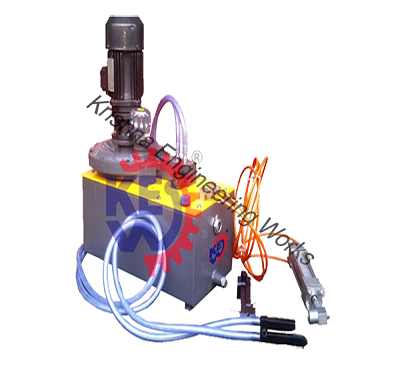
Web Guiding System Manufacturer and Supplier
A web guiding system is an automatic control that keeps a moving web of film, paper, foil or fabric on a fixed line by sensing its edge and shifting a roll stand or steering frame to correct any drift. Krishna Engineering Works makes the web guiding system as an electro-hydro or a hydro-pneumatic web aligner unit, with power packs from 0.25 HP to 3 HP.
The units are manufactured in Ahmedabad, India, and fitted to KEW’s own machines and to machines from other builders. This page compares the two unit types, gives the power pack specification and explains how to choose and install a guide.
What is a web guiding system?
A web guiding system is a closed control loop with three parts: a sensor that reads the web position, a controller that compares it with the set position, and an actuator that moves the web back. It works continuously while the machine runs.
A web never runs perfectly straight on its own. Parent reels are wound with uneven edges, rollers are never exactly parallel, and tension changes as reels empty. Without a guide, the web wanders, and every process after it suffers: print falls out of register sideways, laminated layers do not line up, slit widths change and rewound reels come out with stepped edges.
Krishna Engineering Works supplies guides for accurate alignment of paper, film, fabric and foil, with heavy duty parts suited to slitter rewinders, winding rewinding machines and other winding and unwinding applications.
How does a web guiding system work?
A web guiding system works by turning a small sideways error at the sensor into a movement of a hydraulic cylinder. The sequence repeats many times a second.
- The sensor reads where the web edge is. In an air flow sensor, the web partly blocks an air stream. In a photocell sensor, it partly blocks a light beam.
- The signal goes to the control valve on the power pack, either as an air pressure or as an electrical signal.
- The valve sends oil to one side of the hydraulic cylinder or the other.
- The cylinder moves the unwind stand, the rewind stand or a steering frame.
- The web edge returns to the middle of the sensor, the signal balances and the cylinder stops.
The power pack is a small hydraulic unit: an electric motor, a pump, an oil tank, filters and the control valve. A hydraulic cylinder is used as the actuator because it gives a large, smooth force in a small space and holds its position firmly.
Types of KEW web guiding system
KEW offers two types of web guiding system, and the difference between them is the sensor and the way its signal reaches the hydraulic valve.
Electro-hydro web aligner (power pack) unit
The electro-hydro unit senses the web edge electronically and controls the hydraulics through an electrical panel. As listed by Krishna Engineering Works, the unit consists of:
- An electronic photocell sensor for the edge of the film
- An AC motor
- An electrical panel board to operate the complete unit
- A hydraulic cylinder, an adjuster and the oil pipe
A photoelectric sensor sees opaque and printed materials well, and it can be placed some distance from the power pack because the signal travels by cable.
Hydro-pneumatic web aligner unit
The hydro-pneumatic unit senses the web edge with low pressure air and uses that air signal to pilot the hydraulic valve directly. There is no electronics between sensor and valve. KEW supplies it as a complete kit:
- 0.5 HP motor
- Air pipe, 5 metres
- Oil pipe, 5 metres
- One sensor
- One adjuster
- One air filter
- One oil filter
- One hydraulic cylinder with 6 inch stroke
The air sensor does not touch the web, and the air stream keeps the sensor gap clear of dust. The unit in detail, with its cylinder options, is on the hydro pneumo web aligner system page.
Which type should you choose?
Choose by material, environment and the distance between sensor and power pack. The table sets out the general logic.
| Question | Hydro-pneumatic unit | Electro-hydro unit |
| How is the edge sensed? | Air flow sensor, non-contact | Photocell sensor, non-contact |
| Opaque film, paper, foil, fabric | Suitable | Suitable |
| Clear film | Suitable, since air does not depend on opacity | Check with KEW for the material |
| Very porous or open fabric | Check with KEW, air can pass through the web | Suitable |
| Dusty surroundings | Works well, the sensor is self cleaning | Keep the lens clean |
| Sensor far from the power pack | Limited by air pipe length | Easy, signal by cable |
| Electronics to maintain | None between sensor and valve | Sensor and panel |
Technical specification of the web guiding system
The table gives the published specification of the two standard KEW power packs, type KEW-17 and type KEW-30.
| Item | KEW-17 | KEW-30 |
| Motor rating (3 phase, 50 Hz) | 0.5 HP | 1 HP |
| Pump flow rate | 3.4 l/min | 5.8 l/min |
| Tank capacity | 17 litres | 30 litres |
| Oil type | Servo 32, Enklo 44, Hydro 37 | Servo 32, Enklo 44, Hydro 37 |
| Line pressure | 14 bar | 21 bar |
| Maximum operating force (50.8 mm diameter cylinder) | 260 kg | 389.5 kg |
| Maximum follow up speed | 30 mm/sec | 40 mm/sec |
| Air sensor air pressure | 5 to 28 mbar, infinitely adjustable | 5 to 28 mbar, infinitely adjustable |
| Weight including oil | 40 kg | 60 kg |
Across the range, power units are available from 0.25 HP to 3 HP for any winding and unwinding application.
The two figures that matter most when sizing are operating force and follow up speed. The force must move the heaviest loaded stand against its friction. The follow up speed must be faster than the web can wander at full line speed.
Where is a web guiding system used?
A web guiding system is used wherever the next process needs the web edge in a known place. Krishna Engineering Works lists these applications for its guides:
- Rotogravure printing machines
- Lamination and coating machines
- Slitter rewinder machines
- Doctoring rewinding machines
- Paper machinery
- Textile machines such as batching machines and inspection rewinding machines
- Machines for tyre cord
On the company’s own machines the guide is part of the design. The slitter rewinder machine uses guiding at the unwind so slit widths stay true, and the winding rewinding machine has a movable unwind stage with a hydraulic web aligner. On a rotogravure printing machine and a lamination machine, guides are normally fitted at the unwinds and before the rewind. In a tyre cord line, guiding and centring units are spaced along the dipping plant.
Where should the guide and sensor be fitted?
Fit the guide where it can move the web without fighting the rest of the machine, and put the sensor just after the point of correction. Three arrangements cover most machines.
| Arrangement | What moves | Sensor position | Typical place |
| Unwind guiding | The whole unwind stand, sideways | Fixed to the machine frame, just after the first idler roll | Start of any line |
| Rewind guiding | The rewind stand follows the web | Fixed to the moving rewind stand, on the incoming web | End of a line, for straight reel faces |
| Intermediate guiding | A steering or displacement frame with rollers | Just after the frame’s exit roller | Before a print unit, coater, nip or slitter |
For unwind guiding, a moving sensor would follow its own error, so the sensor stays on the frame. For rewind guiding it is the opposite: the sensor rides with the stand so the stand chases the web. KEW’s catalogue covers the frames and assemblies on the tracking roller assembly and guiding solutions pages, and the power pack alone on the web aligner power pack unit page.
How do you choose and size a web guiding system?
Size the system from the load to be moved and the error to be corrected. A guide that is too weak hunts and overheats. One that is far too large costs more and reacts harshly.
- Decide the guiding point: unwind, rewind or intermediate.
- Add up the moving weight: stand, shaft, chucks and the heaviest full reel.
- Estimate the worst edge error of your incoming reels. This sets the cylinder stroke.
- Note the line speed and how fast the error appears. This sets the follow up speed.
- Choose the sensor for the material, as in the comparison table above.
- Check the stand: it must roll or slide freely on its guides, or no power pack will position it well.
- Choose the power pack whose operating force covers the load with margin.
The group’s specialist site on web guide systems by sensor and actuator type compares edge, line and centre guiding in more detail.
Installing and setting up a web aligner
A web aligner is set up in a few steps, and most guiding complaints come from skipping one of them. The site on web aligner installation and tuning covers the fine points.
- Mount the power pack level, close to the cylinder, and fill it with one of the listed oil types.
- Fix the cylinder in line with the direction of stand travel, with the rod at mid stroke when the stand is centred.
- Mount the sensor square to the web edge, close to the guiding point.
- Connect the oil pipes and, for the hydro-pneumatic unit, the air pipe through the air filter.
- Run the motor and bleed air from the oil lines by stroking the cylinder fully both ways.
- Thread the web and move the sensor until the edge sits in the middle of its gap.
- Run the line slowly. Use the adjuster to set sensitivity so the stand corrects quickly without hunting.
- Run at full speed and check the rewound reel edge.
| Symptom | Likely cause | First check |
| Stand hunts from side to side | Sensitivity too high, or sensor too far from the guiding point | Reduce sensitivity, move the sensor closer |
| Slow or no correction | Low oil level, blocked filter, sticking stand | Oil level, filters, stand slides |
| Web runs to one side and stays | Sensor not at the web edge, or cylinder at end of stroke | Sensor position, centre the cylinder |
| Correction jerky | Air in the oil lines | Bleed the lines |
| Works cold, drifts when warm | Wrong oil grade | Oil type against the list |
Service and spares
Web aligners are among the items Krishna Engineering Works makes in house, so spare parts for the power pack, sensor and cylinder come from the same source as the unit. Installation support, spare parts supply and after sales service are available for customers in India and abroad. See repairing and servicing, or browse the full range on the products page.
What to send for a web guiding system quotation
A web guiding system is matched to your machine. Send:
- Machine type and the guiding point: unwind, rewind or intermediate
- Material, and whether it is opaque, clear, printed or porous
- Web width range and line speed
- Weight of the stand to be moved, with the heaviest reel
- Edge error of your incoming reels, if known
- Power supply, and whether compressed air is available
- Photographs or a drawing of the stand and its slides
Send these through the contact page, and KEW will propose the unit type and power pack.
Frequently Asked Questions
What is the working principle of a web guide sensor?
A web guide sensor detects how much of its gap the web edge covers. An air flow sensor measures the change in an air stream that the web partly blocks, and a photocell sensor measures the change in a light beam. The signal tells the control valve which way the web has moved, and the hydraulic cylinder corrects it.
What is the difference between the KEW-17 and KEW-30 power packs?
The KEW-17 has a 0.5 HP motor, a 17 litre tank, 14 bar line pressure and a maximum operating force of 260 kg, with a follow up speed of 30 mm/sec. The KEW-30 has a 1 HP motor, a 30 litre tank, 21 bar line pressure, 389.5 kg force and 40 mm/sec. The KEW-30 suits heavier stands and faster lines.
Which oil is used in a KEW web aligner power pack?
The published specification for the KEW-17 and KEW-30 power packs lists Servo 32, Enklo 44 and Hydro 37 as the oil types. Use one of these grades and keep the tank at the correct level. Mixing grades or running with a blocked oil filter makes the guide slow and can cause it to drift as it warms up.
Can a web guiding system be fitted to an existing machine?
Yes, a web guiding system can be fitted to an existing machine if the unwind or rewind stand can move sideways, or if there is room for a steering frame. Krishna Engineering Works supplies the hydro-pneumatic unit as a complete kit with motor, pipes, sensor, adjuster, filters and cylinder. Send photographs of the stand with your enquiry.
Does a hydro-pneumatic web aligner need compressed air?
A hydro-pneumatic web aligner needs only a small flow of low pressure air for its sensor. The KEW specification gives the sensor air pressure as 5 to 28 mbar, which is far below normal factory compressed air pressure. The air passes through the air filter supplied with the kit before it reaches the sensor.
What are the benefits of using a web guiding system?
A web guiding system reduces material waste, keeps product quality consistent and allows higher production speed. Print stays in sideways register, laminated layers line up, slit widths hold and rewound reels have straight faces. It also prevents the stoppages that occur when a wandering web folds over or runs off a roller.
How many web guides does a converting line need?
A converting line needs a guide at each point where the web position must be known. A simple rewinder needs one, at the unwind. A printing or lamination line normally has one at each unwind and one before the rewind, and long lines such as tyre cord dipping plants add intermediate guides between sections.

