


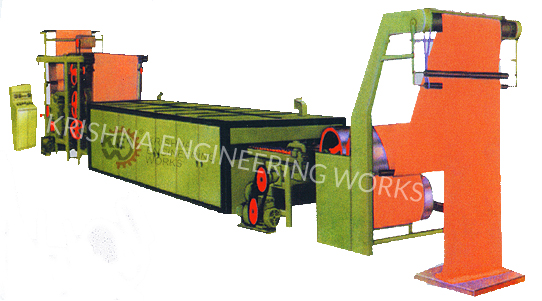
Stenter Machine Manufacturer and Exporter
A stenter machine holds open width fabric by both selvedges on two moving chains, stretches it to a set width and carries it through heated chambers to dry, heat set or cure a finish. Krishna Engineering Works builds the stenter machine section by section, with the length, width and number of chambers made to the buyer’s requirement.
The machine is manufactured in Ahmedabad, India, together with the spare parts for it. This page goes through the machine from the padding mangle at the entry to the selvedge drying unit at the delivery end, then lists what the buyer has to decide.
What does a stenter machine do?
A stenter machine fixes the width and the dimensional stability of a fabric while it dries or sets it. After dyeing, bleaching or washing, a fabric is wet, narrower than it should be and uneven in width. The stenter grips both edges, pulls the fabric out to the finished width and holds it there while hot air does its work.
Krishna Engineering Works lists these applications for its stenter machine:
- Heat setting of polyester, blends and technical fabrics.
- Drying after dyeing, bleaching or washing.
- Finishing: width control, shrinkage control and improved hand.
- Support for printing and coating, where the fabric must be at a stable width before the next process.
A plain dryer only removes water. A stenter removes water while controlling width, and for synthetic fibres it also sets the fabric so that it keeps its dimensions in later washing and wear.
How is the KEW stenter machine built, section by section?
The KEW stenter machine is built as seven sections in line, each with its own job. The fabric passes through them in the order below.
- Pneumatic padding mangle
- Pre-dryer and compensator
- Bow and weft straightener
- Stenter frame with rails and clips
- Drying chambers
- Selvedge drying and plaiting unit
- Heating system, drive and control panel, which serve the whole line
Pneumatic padding mangle
The padding mangle applies the finish and squeezes the fabric to an even moisture content before it enters the heat. The fabric dips into a liquor tank and then passes between squeezing rolls that press out the excess.
On the KEW machine the mangle is constructed from heavy duty MS plate. The tank is heavy duty stainless steel with stainless steel guide rolls, and the squeezing rolls are rubber and ebonite. Pressure is applied pneumatically, which keeps the squeeze even across the width and repeatable from lot to lot. Even squeezing matters because every litre of water left in the fabric has to be evaporated in the chambers.
Pre-dryer and compensator
The pre-dryer takes out part of the moisture by contact before the fabric reaches the stenter frame, and the compensator keeps the two machines in step. KEW builds the pre-dryer with dynamically balanced stainless steel cylinders of 20 to 30 inch diameter, gas heated, on a heavy duty channel frame with guide rolls.
The compensator synchronises the speed of the stenter with the padding mangle. Without it, any small speed difference would either stretch the wet fabric lengthwise or let it sag between the two sections.
Bow and weft straightener
The bow and weft straightener makes the weft threads run square to the selvedges before the fabric is gripped. Wet processing leaves the weft bowed in the centre or skewed from one edge to the other, and whatever shape the fabric has when the chambers set it becomes permanent.
The KEW unit uses two curved rubber sleeve expander rolls and two ebonite rolls, with an auto feeding device for a smooth feed into the frame. The curved rolls work on the same principle as the bow roll used on converting lines: the fabric spreads outward as it passes over the curve, which opens creases and corrects the bow.
Stenter frame, rails and clips
The stenter frame is the pair of long rails that carry the two endless chains through the machine. On the KEW machine the legs and supports are cast iron for vibration free running, the rails are precision cast iron so that the clips travel accurately, and the clips are SG iron castings designed to hold the fabric without damaging it. Heavy sprockets are motor driven, and the rail width is adjustable.
Width is set by moving the rails apart. In general practice the rails are set narrower at the entry, widen gradually to the finished width and then run parallel through the chambers, so the fabric is stretched gently instead of in one step. Clips wear with time, and worn clips let the selvedge slip. The group’s specialist site on stenter clips covers clip types and replacement.
Drying chambers
The drying chambers are the insulated enclosures in which hot air is blown onto the fabric. KEW constructs them from MS angles, insulates them with fibreglass wool and closes them with insulated panels to keep the temperature uniform. The chambers run the full length of the machine.
The number of chambers is the main sizing decision. More chambers give a longer heated length, so the fabric can run faster for the same drying or setting time. Good insulation keeps the heat in the chamber, which lowers fuel use and keeps the working area cooler.
Selvedge drying and plaiting unit
The selvedge drying unit finishes the edges at the delivery end. The selvedges are the last part of the fabric to dry, because they were held by the clips and are often denser than the body. KEW fits a heavy MS plate frame with stainless steel heated cylinders that dry the selvedges quickly, with an integrated plaiting unit that folds the fabric down as it leaves the machine.
Heating system
The KEW stenter is gas fired, with infrared radiant burners. The standard supply includes the copper connections, regulating valves and needle valves for the burners. V type burners with the associated equipment are available as an option for heating efficiency.
Drive, control panel and finish
The machine runs on a DC drive. The main drive motors of the padding mangle and of the stenter are DC motors, and a reduction gear box is coupled to the main stenter motor. The control panel is a powder coated sheet steel cabinet fitted with switch gear of the required capacity.
The machine is finished with primer and industrial paint, with powder coating as an option. An operating manual, the wiring diagram of the control panel and a foundation plan are supplied with the machine.
What each section contributes
The table summarises the sections and the fault each one prevents, which is a quick way to check a specification.
|
Section |
What it does |
What goes wrong without it |
|
Pneumatic padding mangle |
Applies finish and squeezes to even moisture |
Uneven finish, patchy drying |
|
Pre-dryer |
Removes part of the water by contact |
Chambers overloaded, lower speed |
|
Compensator |
Matches mangle speed to stenter speed |
Lengthwise stretch or slack fabric |
|
Bow and weft straightener |
Squares the weft and opens creases |
Bow and skew set permanently |
|
Rails and clips |
Hold both selvedges at the set width |
Width variation, torn selvedges |
|
Drying chambers |
Dry, heat set or cure in hot air |
Under dried or under set fabric |
|
Selvedge drying unit |
Dries the edges and plaits the fabric |
Damp selvedges, marks in the stack |
What does the buyer decide?
The buyer decides the working width, the number of chambers and the drive and motor ratings, because Krishna Engineering Works builds the length, the width and the chamber count to the buyer’s requirement. The company publishes no fixed dimensions for this reason.
Work through the decisions in this order:
- List the fabrics: fibre, construction and weight per square metre for each.
- Fix the widest finished width, and the narrowest, so the rail adjustment covers both.
- State the process for each fabric: drying only, heat setting, or curing a finish.
- Set the output you need in metres per shift.
- From the process and the output, agree the number of chambers with KEW.
- Confirm the gas supply available at your site.
- Decide which entry and exit sections you need: padding mangle, pre-dryer, straightener, plaiting or batching.
- Check the floor length and the foundation requirements against the foundation plan.
KEW also offers two variants with their own pages: the hot air stenter machine and the open and batching stenter machine, which delivers the fabric onto a batch roll.
Stenter faults and their usual causes
Most finishing faults on a stenter trace back to one section. The table gives a first check for each.
|
Fault |
Likely cause |
First check |
|
Width varies along the piece |
Selvedge slipping in worn clips |
Clip condition, rail setting |
|
Bowed or skewed weft |
Straightener not set, or uneven feed |
Expander roll position, feed tension |
|
Centre and edges differ in shade or handle |
Uneven squeeze at the mangle |
Pneumatic pressure, squeezing roll surface |
|
Damp selvedges |
Selvedge cylinders not hot enough |
Selvedge drying unit temperature |
|
Harsh handle or yellowing |
Chamber temperature too high for the fabric |
Burner regulation, fabric speed |
|
Residual shrinkage too high |
Too little time at setting temperature |
Speed against number of chambers |
Related textile processing machines
A stenter works at the end of a wet processing sequence, and Krishna Engineering Works builds the machines around it.
- The jigger machine dyes the fabric in open width before finishing.
- The bowl mangle and drying range squeezes and cylinder dries fabric that does not need width setting.
- The cloth guider keeps the fabric centred at the entry.
- Clips, chain parts and other wear items are on the spares of stenter page.
The group’s site on textile machinery spare parts covers spares across textile processing in more detail. The full KEW catalogue is on the products page.
Installation and service
Krishna Engineering Works installs and commissions the machine at the customer’s site and trains the operators, in India and abroad. Textile spares are made in the company’s own factory, so clips, rolls and other wear parts come from the same source as the machine.
Spare parts supply and technical support continue after startup. See repairing and servicing for the scope.
What to send for a stenter machine quotation
A stenter machine is quoted from your fabrics and your output. Send:
- Fabrics to be processed: fibre, woven or knitted, and weight per square metre
- Finished width range, widest and narrowest
- Process: drying, heat setting, finishing or curing
- Output required per shift
- Entry sections needed: padding mangle, pre-dryer, bow and weft straightener
- Delivery needed: plaiting or batching
- Gas supply and power supply at your site
- Available floor length
Send these through the contact page, and KEW will propose the width, the number of chambers and the drive.
Frequently Asked Questions
What does a stenter machine do to fabric?
A stenter machine stretches fabric to a set width and dries or heat sets it while holding both selvedges. The fabric leaves at an even width, with controlled shrinkage and a stable shape. For synthetic fabrics such as polyester, the heat also sets the fibres so the fabric keeps its dimensions in later washing.
What is the difference between a dryer and a stenter?
A dryer removes moisture, while a stenter removes moisture and controls the width of the fabric at the same time. The stenter holds the selvedges on chains, so the fabric cannot shrink in as it dries. A stenter can also heat set synthetic fibres and cure finishes, which a simple cylinder dryer cannot do.
How many drying chambers does a stenter need?
The number of drying chambers depends on the fabric weight, the process and the output you need. Heavier fabrics and heat setting need more time in the heat, so they need more chambers for the same speed. Krishna Engineering Works builds the number of chambers to the buyer’s requirement, so send your fabrics and target output.
Why is a padding mangle fitted before the stenter?
A padding mangle is fitted before the stenter to apply the finish and to squeeze the fabric to an even, low moisture content. The KEW mangle uses pneumatic pressure with rubber and ebonite squeezing rolls. Even squeezing gives an even finish across the width, and less water in the fabric means less fuel used in the chambers.
What heating system does the KEW stenter use?
The KEW stenter uses a gas fired heating system with infrared radiant burners. The standard supply includes copper connections, regulating valves and needle valves. V type burners with the associated equipment are available as an option. The pre-dryer cylinders are also gas heated, so the machine needs a gas supply at the site.
Why does fabric come out of the stenter with bowed weft?
Fabric comes out with bowed weft when the weft threads were not straight as the fabric entered the chambers, because heat sets whatever shape the fabric has. The bow and weft straightener at the entry corrects this with curved expander rolls. Check that the expander rolls are set correctly and that the feed tension is even.
Can the stenter width be changed for different fabrics?
Yes, the stenter width can be changed, because the rails that carry the clip chains are adjustable. The KEW stenter frame has a width adjustment system with motor driven sprockets. Give the widest and the narrowest finished width you run when you order, so that the adjustment range of the machine covers all of your fabrics.

