

Bow Roll Manufacturer: Banana Roller and Expander Roll in Three Types
A bow roll is a curved, rotating roller that spreads a moving web sideways, so wrinkles are pulled out before the web reaches a nip, a slitter or a winder. Krishna Engineering Works manufactures the bow roll, also called a banana roller or expander roll, in three types, in diameters up to 300 mm and lengths up to 8000 mm.
The rolls are made in Ahmedabad, India, to the customer’s specification. This page is the catalogue entry: the types, the stated limits, the coverings, the mounting and the data needed for an order.
What is a bow roll made of?
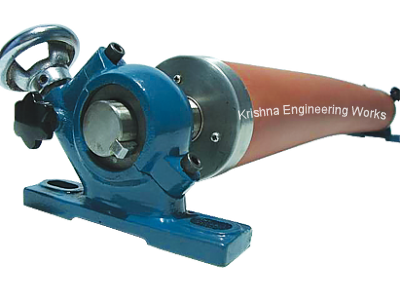
A bow roll is made of a fixed curved shaft that carries a row of rotating segments under one continuous sleeve. The shaft does not turn. Only the sleeve and the segments turn, driven by the web or by a separate drive.
Krishna Engineering Works lists these parts for its bow rolls:
- Curved shaft. The stationary axle that sets the bow.
- Metal segments. Short sleeves that follow the curve of the shaft.
- Sealed ball bearings. One set under each segment, so every segment turns freely.
- Abrasion resistant rubber sleeve. The continuous cover that touches the web.
- Brackets. Foot mount or wall mount, depending on the machine.
Bow roll types made by Krishna Engineering Works
Krishna Engineering Works makes three types of bow roll. They differ in the surface that touches the web and in whether the bow can be changed.
|
Type |
Surface |
Bow |
Best suited to |
|
Rubber sleeve covered bow roller |
Synthetic nitrile rubber sleeve |
Set at manufacture |
General wrinkle removal with good grip |
|
Metal expander roll |
Hard chrome plated metal |
Set at manufacture |
High speed lines, long surface life |
|
Variable bow expander roll |
Covering to suit the web |
Adjustable |
Lines that run different materials |
Rubber sleeve covered bow roller
The rubber sleeve covered bow roller is the standard design. Its sleeve is made of synthetic nitrile rubber, which grips the web well, and that grip is what moves the web outward. It gives strong wrinkle removal on most films, papers and fabrics.
Metal expander roll (hard chrome plated)
The metal expander roll has a hard chrome plated surface instead of a rubber sleeve. KEW offers it for high speed applications, where a rubber sleeve would heat up and wear. The plated surface has a long life and resists wear.
Variable bow expander roll
The variable bow expander roll has an adjustable bow, so the amount of spreading can be changed when the material changes. KEW recommends it for flexible packaging, printing and lamination, where one machine runs thin films one day and heavier laminates the next.
Sizes, mounting and coverings stated by KEW
Krishna Engineering Works states the limits below for its bow rolls. Inside these limits each roll is made to the customer’s line.
|
Item |
Stated figure or option |
|
Diameter |
Up to 300 mm |
|
Length |
Up to 8000 mm |
|
Mounting |
Foot mounted or wall mounted |
|
Working style |
Single acting and double acting rolls |
|
Covering materials |
Rubber, nylon, EPDM, silicone, ebonite, synthetic nitrile |
|
Metal surface option |
Hard chrome plated |
The bow height, the face length and the sleeve hardness are not standard figures. They are decided from the web, the tension and the speed, which is why the enquiry list at the end of this page asks for them.
Which covering should you choose?
Choose the covering from what touches the roll: the web surface, any solvent or coating on it, and the temperature. The table gives general industry guidance for the materials KEW lists.
|
Covering |
General strengths |
Typical use |
|
Synthetic nitrile |
Good grip, resists oils and many ink solvents |
Printing, lamination, general converting |
|
EPDM |
Resists water, steam, ketones and esters |
Wet textile processing, ketone based inks |
|
Silicone |
Resists heat, releases sticky materials |
Hot webs, adhesive coated webs |
|
Nylon |
Hard wearing, low friction |
Abrasive webs, light spreading |
|
Ebonite |
Hard, chemically resistant |
Textile wet processing |
|
Hard chrome plated metal |
Long life at speed, easy to clean |
High speed film and paper lines |
Solvent resistance is the usual reason a sleeve fails early. If the plant changes its ink or adhesive system, check the sleeve compound again. Compound and hardness are explained on the rubber roller page.
How does a bow roll remove wrinkles?
A bow roll removes wrinkles because the web leaves the roll at right angles to the curved surface, so each half of the web is steered outward from the centre. The web is stretched slightly across its width, and that stretch pulls folds flat.
Krishna Engineering Works states that the performance depends on three things: the wrap angle, the lead in and lead out distances, and the position of the bow, which is adjustable. A lead in to lead out ratio of 3 to 1 is considered best, with the roll set square to the web direction.
That is as far as this catalogue page goes. The theory of bow, wrap and spreading force is set out on the group’s banana roll engineering resource.
What a bow roll does on the line
A bow roll corrects several web faults with one part. KEW lists these results:
- Removes wrinkles and a baggy centre
- Controls slack edges
- Separates slit webs on a winder, so neighbouring reels do not interleave
- Evens out the tension across the web width
On a slitter rewinder machine the roll sits after the knives to open small gaps between the slit strips. On a lamination machine and a coating machine it sits just before the nip, because a wrinkle that enters a nip becomes a permanent crease. On a rotogravure printing machine or a flexo press it flattens the web ahead of the first print station.
In textile lines, curved expanders open the fabric before a stenter machine or a batching unit. KEW also lists bow rolls for paper and plastic film converting.
Bow roll or another spreader?
A bow roll is the strongest of the common spreaders, and it is adjustable, but it is not the only one. The comparison below is general practice.
|
Spreader |
Spreading action |
Adjustment |
Typical use |
|
Bow roll |
Strong, across the full width |
Bow position, and bow height on the variable type |
Before nips, slitters and winders |
|
Grooved roller |
Light |
None |
Idler positions on film and foil lines |
|
Slat expander roller |
Positive, at slow speed |
Cam setting |
Cloth coating, artificial leather |
|
Metal industrial roller, plain |
None |
None |
Carrying the web only |
How to mount and set a bow roll
A bow roll is mounted across the machine on two brackets, with the bow pointing in the direction that tightens the web. Foot mounted brackets stand on a cross member or the machine base. Wall mounted brackets bolt to the inside of the side frames. Choose whichever the frame allows without moving other rollers.
The steps below are general good practice for setting any bow roll.
- Fit the roll square to the web direction and level across the machine.
- Keep the entry span long and the exit span short. Aim for the 3 to 1 ratio that KEW considers best.
- Start with the bow pointing along the bisector of the wrap angle, in the direction the web travels.
- Thread the web with a moderate wrap. Too little wrap gives no grip, and too much distorts the web.
- Run at low speed and turn the bow position a little at a time until the wrinkles clear.
- Use the least spreading that works, then lock the shaft and mark the position.
- Check that every segment turns freely by hand before each long run.
Faults and what to check
Most bow roll problems come from the setting, not from the roll. The table lists the common ones.
|
Symptom |
Likely cause |
First check |
|
Wrinkles remain |
Too little wrap, or bow pointing the wrong way |
Wrap angle and bow position |
|
Edges stretched or curled |
Too much bow for the material |
Reduce the bow, or turn it toward neutral |
|
Web slips on the sleeve |
Sleeve glazed, or wrap too small |
Sleeve surface, wrap angle |
|
Scratches or drag marks |
A segment bearing has seized |
Turn the sleeve by hand along its length |
|
Sleeve cracked or swollen |
Compound does not suit the solvent |
Solvent in use, sleeve material |
|
Wrinkles return before the nip |
Exit span too long |
Distance from roll to the next roller |
A worn sleeve can be replaced without scrapping the shaft and segments. For this work, see repairing and servicing. The rest of the catalogue is on the products page.
What to send for a bow roll quotation
A bow roll is made to your line. Send:
- Type: rubber sleeve covered, hard chrome plated metal, or variable bow
- Face length and overall length, and the roll diameter if it must match an existing roll
- Web material, thickness range and maximum web width
- Maximum line speed and web tension
- Covering material, or the inks, solvents, adhesives and temperature at the roll
- Mounting: foot or wall, with the distance between the side frames
- Position on the machine and the fault to be corrected
- Quantity, or the details of the old roll if it is a replacement
Send these through the contact page.
Frequently Asked Questions
What is the purpose of a bow roll?
The purpose of a bow roll is to spread a moving web across its width. It removes wrinkles, takes up a baggy centre, controls slack edges and separates slit webs on a winder. It is fitted in printing, packaging, lamination, textile, paper and film machines, usually just before a nip, a slitter or a winder.
What sizes of bow roll does Krishna Engineering Works make?
Krishna Engineering Works makes bow rolls in diameters up to 300 mm and lengths up to 8000 mm. Within these limits each roll is made to the customer’s specification, so the face length, the bow and the covering follow the web width, the material and the speed of the line.
Which covering materials are available for a bow roll?
Bow rolls from Krishna Engineering Works are available with rubber, nylon, EPDM, silicone, ebonite and synthetic nitrile coverings. A hard chrome plated metal expander roll is offered for high speed applications. The right covering depends on the web, the solvents and the temperature at the roll, so state these in the enquiry.
Are bow roll, bowed roll and banana roller names for one product?
Yes, a bow roll and a banana roller are the same product. The names bow roll, bowed roll, banana roller, expander roll and spreader roll are all used for a curved roller that spreads a web. The name banana roller simply comes from the curved shape of the shaft and sleeve.
What is a variable bow expander roll?
A variable bow expander roll is a bow roll whose bow can be adjusted. The operator can increase the spreading for a material that wrinkles easily and reduce it for a delicate one. It suits flexible packaging, printing and lamination machines, which run many different materials on the same line.
Where should a bow roll be fitted on a machine?
A bow roll should be fitted close before the point where wrinkles do damage, such as a nip, a slitter or a winder. Keep the entry span long and the exit span short. Krishna Engineering Works states that a lead in to lead out ratio of 3 to 1 is considered best.
How can a bow roll be mounted?
A bow roll can be foot mounted or wall mounted. Foot mounted brackets stand on a cross member or the machine base, and wall mounted brackets bolt to the inside of the side frames. Give the distance between the frames and the space available, and the brackets are made to suit the machine.
Bow Roll Technical Specifications
- Diameter: Up to 300 mm
- Length: Up to 8000 mm
- Mounting: Foot Mounted / Wall Mounted
- Working Style: Single Acting & Double Acting Rolls
- Building Materials Available: Rubber, Nylon, EPDM, Silicon, Ebonite, Synthetic Nitrile
Bow Roll Working
The performance of a Bow Roll is determined by:
- Wrap angle
- Lead-in & Lead-out distance
- Position of bow (adjustable)
- The best performance typically occurs with a 3:1 lead-in: lead-out ratio with the Bow Roller perpendicular to the web direction.
Benefits of Our Bow Roll
- Eliminates wrinkles and baggy centres
- Maintains slack edge control
- Separates slit webs on winders
- Improves tension across entire web width
- Provides Production Efficiency
Uses for Bow Roll
Bow Rolls (Banana Rollers) are used in:
- Printing Machines (Flexo, Gravure, Offset)
- Lamination Machines
- Textile Flow Lines
- Paper & Film Converting
- Packaging Industry
Why Krishna Engineering Works?
- Over 25+ years in industrial machinery manufacturing
- Exporting to USA, Brazil, Russia, France, Canada, Mexico, South Africa & more
- Custom sizes & materials
- International quality standards
Looking for the best Bow Roll Manufacturer in India?
📞 Call us now at +91-8460728298 or visit us www.krishnaengineeringworks.com
🔹 FAQs about Bow Rolls
Common inquiries regarding Bow Roll.
Q1: What is the purpose of a Bow Roll?
A Bow Roll (also known as a Banana Roller) is a equipment employed in the printing, packaging and converting industries to extract wrinkles, regulate the web tension and separate slit webs.
Q2: What sizes is Bow Roll product comes in?
We provide Bow Rolls that can be made in diameters of up to 300 mm and lengths of up to 8000 mm, made to customer specifications.
Q3: What type of materials can Bow Rolls be made from?
Bow Rolls can also be made with rubber, EPDM, silicon, nylon, synthetic nitrile, or hard chrome plated metal for high speeds applications.
Q4: Which industries would use the Bow Roll?
Bow Rolls are used in multiple industries ranging from packaging, printing, lamination, textile, paper and film processing industries.
Q5: What is the differentiator between Single Acting Bow Roll and a Double Acting Bow Roll?
A Single Acting Bow Roll is fixated while, the Double Acting Bow Roll adjusts the bow angle application provides positive enhancement flexibility.
Q6: Do you supply Bow Rolls overseas?
Yes, we supply Bow Rolls all over the globe including the USA, Canada, Brazil, Russia, France, Australia, Mexico, South Africa or etc.

