

Coating Machine Manufacturer and Exporter
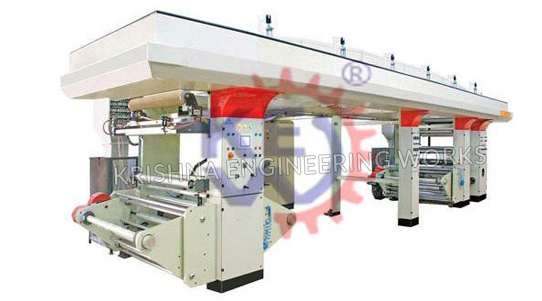
A coating machine applies a thin, even layer of liquid, such as silicone, adhesive or a barrier lacquer, to a moving web of paper or film and dries it before rewinding. Krishna Engineering Works builds the coating machine with a gravure or reverse roll coating section and a multi zone arch dryer, for web widths of 600, 800, 1000 and 1200 mm.
The machine is manufactured in Ahmedabad, India, and set up for the coating chemistry and substrate of each buyer. This page explains the two coating methods, the coating types the company names, the dryer and the published specification.
What does a coating machine do?
A coating machine gives a web a surface property it does not have on its own. A release liner needs a surface that labels peel from. A sticker sheet needs an adhesive layer. A packaging film needs a barrier to moisture and oxygen, or a layer that seals with heat. In each case the property comes from a coating a few microns thick.
The machine has four jobs, and the result depends on all of them:
- Unwinding the base web at steady tension and on a fixed line.
- Metering the liquid, so the same amount reaches every square metre.
- Drying or curing the wet layer without disturbing it.
- Rewinding the coated web without blocking, which is when layers stick to each other in the reel.
Gravure and reverse roll coating: how do they differ?
The KEW coating machine is offered with either a gravure or a reverse roll coating section, and the choice depends on coat weight and on the viscosity of the liquid. Both methods meter the liquid before it reaches the web, which is what makes them accurate.
Gravure coating
In gravure coating an engraved roll carries the liquid in its cells. The roll turns in a tray, a doctor blade wipes the surface clean, and the cells then transfer their contents to the web against a rubber backing roll.
The coat weight is fixed mainly by the engraving: the cell volume and the number of cells per unit length. This makes gravure very repeatable from one run to the next, and well suited to thin coatings of low viscosity liquids. Changing the coat weight by a large step means changing the engraved roll.
Reverse roll coating
In reverse roll coating the liquid is metered in the gap between two precisely ground rolls, and the applicator roll then wipes the film of liquid onto the web while turning against the direction of web travel. Because the roll surface and the web move in opposite directions at the transfer point, the coating is laid down smoothly without the pattern of an engraving.
The coat weight is adjusted by the gap and by the relative roll speeds, so one set of rolls covers a wide range. Reverse roll suits heavier coats and higher viscosity liquids, such as many adhesives.
Which method suits your coating?
Choose the method from the coat weight, the viscosity and how often the coat weight changes. The table gives the general selection logic.
| Question | Gravure coating | Reverse roll coating |
| How is the liquid metered? | By the cells of an engraved roll and a doctor blade | By the gap and speed ratio between two rolls |
| Typical coat weight | Thin coats | Medium to heavy coats |
| Liquid viscosity | Low | Medium to high |
| Changing coat weight | Small changes by solids content, large changes by a new roll | By adjusting gap and roll speeds |
| Surface finish | Good, may need a smoothing bar for some liquids | Very smooth |
| Main wear part | Engraved roll and doctor blade | Roll surfaces and bearings |
Which coatings does the KEW coating machine apply?
Krishna Engineering Works names five coating types for its coating machine range. Each has a different chemistry and a different demand on the dryer.
| Coating type named by KEW | Usual purpose | What the machine must get right |
| Silicone | Release surface on label liners and tape backings | A very thin, pinhole free coat and full cure |
| Gum coating for sticker sheet | Adhesive layer for stickers and labels | A heavier, even coat and thorough drying |
| Paper coating | Surface finish or functional layer on paper | Moisture balance, so the paper stays flat |
| VMCH | Heat seal lacquer and primer, often on foil | Complete solvent removal |
| PVDC | Barrier layer against moisture and oxygen | A continuous film without cracks, at controlled temperature |
Silicone and adhesive coating often work as a pair. A release liner is silicone coated on one machine pass, and the face material is adhesive coated and married to it on another. Tape lines follow the same logic: the group’s site on BOPP tape making shows how adhesive coating fits into tape production.
How does the multi zone arch dryer work?
The dryer on the KEW coating machine is a multi zone arch type: the web travels over a gently curved path of idler rolls inside a hot air hood that is divided into zones. The arch keeps the web in firm contact with each roll under light tension, so the web runs flat and does not flutter while the coating is wet.
Dividing the dryer into zones lets the temperature rise in steps. In general practice the first zone is the mildest. If the surface of the coating is heated too hard at the start, it forms a skin, and the solvent beneath then breaks through as blisters or pinholes. Later zones run hotter to drive off the remaining solvent and, for coatings that need it, to complete the cure.
Three settings govern drying, and they trade against each other:
- Air temperature in each zone, limited by what the substrate can take.
- Air velocity at the web, which carries the vapour away.
- Time in the dryer, which is dryer length divided by line speed.
After the dryer the web is usually cooled before rewinding, because a warm reel is more likely to block. KEW makes cooling and heating drums for this duty.
Technical specification of the coating machine
The table gives the specification of the coating machine as published by Krishna Engineering Works. Other sizes are built to the buyer’s requirement.
| Item | Specification |
| Working speed | 140 to 200 m/min |
| Maximum web width | 600, 800, 1000 or 1200 mm |
| Unwind roll diameter | 600 or 800 mm |
| Rewind roll diameter | 600 or 800 mm |
| Drying section | Multi zone arch type |
| Coating section | Gravure or reverse roll |
The working speed of your machine in production depends on the coat weight and the solvent, since both set how long the web must stay in the dryer.
Why do tension and guiding matter on a coating line?
Tension and guiding matter because a coating can only be as even as the web is flat and straight at the coating head. A slack edge takes more coating than a tight centre. A web that wanders leaves an uncoated strip on one side and wet coating on the backing roll on the other.
Steady tension from full reel to empty core is held by a brake or drive that responds to a tension measurement. KEW supplies tension control units for this. An edge guide at the unwind, from the KEW web guiding system range, keeps the web on line before the coating head, and a second guide before the rewind gives straight reel faces.
Idler rolls through the dryer must turn freely and run true, or they scratch the uncoated side and upset tension. Balanced rolls for this purpose are in the industrial roller range.
Coating faults and their usual causes
Most coating faults come from the metering, the drying or the web path. The table gives a first check for each.
| Fault | Likely cause | First check |
| Streaks in the machine direction | Damaged doctor blade or dirt under it | Blade edge, filtration of the liquid |
| Coat weight drifting | Viscosity changing as solvent evaporates | Viscosity control, tray level |
| Pinholes or blisters | First dryer zone too hot | Zone temperature profile |
| Coating still tacky at the rewind | Too little drying time or air flow | Line speed, air velocity, exhaust |
| Blocking in the reel | Web rewound warm or not fully dried | Cooling before rewind, rewind tension |
| Uncoated strip at one edge | Web wandering at the coating head | Edge guide sensor position |
| Curl in coated paper | Moisture lost in the dryer | Final zone temperature, remoistening |
How does a coating machine differ from a lamination machine?
A coating machine dries the coating and rewinds a single web, while a lamination machine dries an adhesive and then presses a second web onto it in a nip. The two share the unwind, the coating head and the dryer, which is why they are often discussed together.
If your coated web must be joined to a second web in the same pass, look at the KEW lamination machine. If the base web is printed first, the rotogravure printing machine comes before the coater, and coated reels are cut to width afterwards on a slitter rewinder machine. The whole range is listed on the products page.
Installation and service
Krishna Engineering Works runs a continuous trial of each machine before dispatch and invites the customer to the factory to see it. Engineers install and commission the machine on site and train the operators, for customers in India and abroad.
Spare parts and technical support continue after commissioning. On a coater the usual wear items are doctor blades, backing rolls and guide parts. See repairing and servicing for the scope.
What to send for a coating machine quotation
A coating machine is quoted from your coating and your substrate. Send:
- Base material, with thickness or GSM range and maximum web width
- Coating type: silicone, gum, PVDC, VMCH, paper coating or other
- Whether the coating is solvent based or water based, with solids content and viscosity if known
- Dry coat weight required, and how often it changes
- Parent reel diameter, weight and core size
- Production speed required
- Coating method preferred, gravure or reverse roll, if already decided
- Power supply and available floor length
Send these through the contact page, and KEW will propose the coating section, dryer and width.
Frequently Asked Questions
What is a coating machine used for?
A coating machine is used to apply a thin, even layer of liquid to a moving web and dry it before rewinding. Typical products are silicone coated release liners, gummed sticker sheets, barrier coated films and coated papers. The coating gives the web a property such as release, adhesion, heat sealing or a barrier to moisture.
What is the difference between gravure and reverse roll coating?
Gravure coating meters the liquid in the cells of an engraved roll, so the engraving fixes the coat weight. Reverse roll coating meters it in the gap between two rolls and wipes it onto the web against the direction of travel. Gravure suits thin coats of low viscosity liquids. Reverse roll suits heavier coats and thicker liquids.
Which coating types does the KEW coating machine handle?
Krishna Engineering Works names silicone coating, gum coating for sticker sheet, paper coating, VMCH coating and PVDC coating for its coating machine range. Each needs its own coat weight and drying profile, so the machine is configured for the coatings you list. Mention every coating you plan to run when you send your enquiry.
What web widths and speed are offered?
The published specification gives maximum web widths of 600, 800, 1000 and 1200 mm and a working speed from 140 to 200 m/min. Unwind and rewind roll diameters are 600 or 800 mm. Other sizes are built to the buyer’s requirement, and production speed depends on the coat weight and the solvent to be dried.
What is a multi zone arch dryer?
A multi zone arch dryer is a hot air dryer in which the web runs over a curved path of idler rolls through several separately heated zones. The arch keeps the web flat and supported. The zones let the temperature rise in steps, so the coating dries from the inside out without skinning, blistering or pinholes.
Why does a coated reel block after rewinding?
A coated reel blocks when the coating is still soft as the layers are wound against each other. The usual causes are incomplete drying, a web that is rewound warm, or rewind tension that is too high. Check the dryer settings and line speed first, then the cooling before the rewind and the winding tension.
Can one machine apply both silicone and adhesive coatings?
One machine can apply both if it is specified for both, but they are normally run as separate jobs with thorough cleaning between them. Silicone is a thin coat that needs full cure, and adhesive is a heavier coat that needs longer drying. Traces of silicone also spoil adhesion, so many plants keep a separate coating head for each.

