


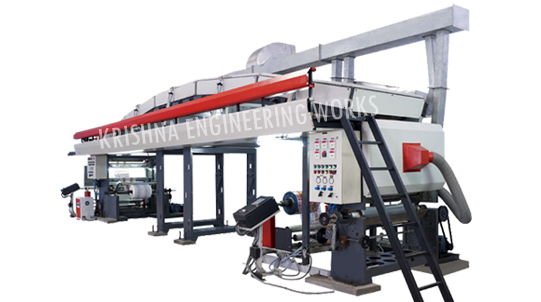
Lamination Machine Manufacturer and Exporter
A lamination machine bonds two or more webs, such as film, paper and aluminium foil, into one layered material by applying adhesive to one web, drying it and pressing the webs together in a nip. Krishna Engineering Works builds the lamination machine in widths from 300 to 1500 mm, with a drying tunnel from 15 to 45 feet long.
The machine is manufactured in Ahmedabad, India, and configured for the substrates, adhesive and reel sizes of each buyer. This page describes how the machine is built, the ranges the company states, and the decisions to make before ordering.
What does a lamination machine do?
A lamination machine combines materials so that the finished web has properties no single layer can give. One layer carries the print, one gives a barrier to moisture or oxygen, and one gives heat sealing. Lamination is how these layers become one packaging material.
In flexible packaging the usual sequence is printing, lamination, curing, slitting and pouch making. The printed web is normally laminated with the ink trapped between the layers, which protects the print from scuffing and from contact with the packed product.
The KEW film lamination machine works with a polyester (PET) base film and applies adhesive evenly so that it bonds to paper, foil, BOPP and HDPE fabric. The machine is also described by the company as compatible with coating and slitting duties, so one line can be planned around several jobs.
How is the KEW lamination machine built?
The KEW lamination machine is built as a line of sections in the order the web meets them: the unwinds, a coating head, a hot air drying tunnel, a laminating nip and a rewind. The web that receives the adhesive is called the primary web. The web that joins it at the nip is the secondary web.
Unwinds for the primary and secondary webs
Each unwind holds a parent reel and releases it at a steady, low tension. Tension matters more in lamination than in most converting jobs, because the two webs are locked together at the nip in whatever stretched state they arrive. If one web is stretched more than the other, the laminate curls when the tension is released.
Each web is also aligned before it reaches the nip. A web guiding system at each unwind keeps the two edges on the same line, so the laminate has no bare margin on one side.
Coating head
The coating head meters the adhesive onto the primary web at a controlled coat weight. In general practice the head uses an engraved gravure roll that picks up adhesive from a tray, a doctor blade that wipes the surface so only the cells stay full, and a rubber impression roll that presses the web onto the engraved roll.
Coat weight is set mainly by the engraving and by the solids content of the adhesive. An even coat is the basis of bond strength: thin patches give weak bonds, and heavy patches trap solvent. The same head design is the heart of the KEW coating machine, which applies functional coatings instead of adhesive.
Hot air drying tunnel
The drying tunnel removes the solvent or water from the adhesive before the webs meet. Krishna Engineering Works offers tunnel lengths from 15 to 45 feet and a hot air temperature from 50 to 155 degrees Celsius, with an option up to 250 degrees Celsius. A hot air generator is available as an optional heat source.
The tunnel on the KEW machine has a special shape that guides the substrate precisely through the hot zone, and the design is thermally efficient so that it uses less power. Tunnel length and line speed are linked: the adhesive needs a certain time in the hot air, so a faster machine needs a longer tunnel for the same coat weight.
Laminating nip
The nip is where the bond is made. The dried, tacky adhesive on the primary web meets the secondary web between a heated steel roll and a rubber covered pressure roll. Heat reactivates the adhesive and pressure forces it into full contact with the second surface.
The pressure roll must be evenly ground and of the right hardness, or the bond varies across the width. Pressure rolls are part of the KEW rubber roller range and can be re-covered when the surface wears or hardens.
Rewind
The rewind winds the laminate into a tight, straight reel for curing. Most reactive adhesives reach full bond strength only after the reel has rested, so the reel must be wound firmly enough to keep the layers in contact, without crushing the core end of the reel.
Stated ranges of the KEW lamination machine
The table gives the ranges that Krishna Engineering Works publishes for the lamination machine. The machine is built to order, so other widths and combinations are agreed against the buyer’s data.
| Item | Stated range |
| Lamination width | 300 to 1500 mm |
| Drying tunnel length | 15 to 45 feet |
| Unwind and rewind diameter | 600 to 1000 mm |
| Hot air temperature | 50 to 155 degrees Celsius, optional up to 250 degrees Celsius |
| Machine speed | 60 to 200 m/min |
| Heat source | Hot air generator (optional) |
| Substrates | Polyester, polyethylene, paper, BOPP, aluminium foil, HDPE fabrics |
The speed a given machine reaches in production depends on the adhesive, the coat weight and the tunnel length chosen, so quote your real job when you ask for a speed.
Which substrates can be laminated?
The KEW lamination machine laminates polyester, polyethylene, paper, BOPP, aluminium foil and HDPE fabrics. Each behaves differently under heat and tension, and the machine is set up for the most demanding one in the buyer’s list.
| Substrate | Typical role in a laminate | What the machine must control |
| Polyester (PET) film | Printed outer layer, stiff and heat stable | Even adhesive coat, clean surface |
| BOPP film | Printed or clear outer layer | Low tension and moderate tunnel temperature, since it shrinks with heat |
| Polyethylene film | Heat sealing inner layer | Very low tension, because it stretches easily |
| Aluminium foil | Barrier layer | Gentle web path and steady tension, because it tears and creases |
| Paper | Stiffness and printability | Moisture and curl after drying |
| HDPE fabric | Strength for sacks and tarpaulin | Adhesive quantity on a rough, open surface |
Aluminium foil is the least forgiving of these. It does not stretch, so any tension step shows as a crease or a break. Extensible films such as polyethylene are the opposite: they stretch at low tension and pull back later, which causes curl. A line that runs both needs a wide tension range at each unwind.
Which lamination process does your product need?
Choose the process from the adhesive and the end use, then size the machine. The table sets out the common processes in general terms.
| Process | How the bond is made | Typical use |
| Dry bond lamination | Adhesive is coated, dried in a tunnel, then bonded in a heated nip | Film to film and film to foil for food packaging |
| Wet bond lamination | Webs are joined while the adhesive is wet, and it dries through a porous web | Paper to foil and paper to film |
| Thermal lamination | A film that already carries a heat activated layer is bonded by a heated roll | Print finishing on paper and board |
A machine with a coating head, a drying tunnel and a heated nip, as described on this page, is laid out for dry bond work. Tell KEW if you also need wet bond jobs on paper, because that changes where the nip sits in relation to the tunnel.
How do you choose the configuration?
Work from the laminate structure back to the machine. The structure decides the adhesive, the adhesive decides the drying, and the drying decides the tunnel.
- List every laminate structure you plan to run, layer by layer, with thicknesses.
- Fix the widest web and the largest parent reel diameter and weight.
- Choose the adhesive type with your adhesive supplier, and note its solids content and coat weight.
- Set the production speed you need for your order sizes.
- From coat weight and speed, agree the tunnel length and temperature with KEW.
- Decide the heat source that suits your plant.
- Decide whether the line must also coat or slit.
If lamination must follow printing without a second pass, the alternative is a rotogravure printing machine with online lamination, which adds the laminating section to the end of the press.
Lamination faults and their usual causes
Most lamination faults trace back to coat weight, drying or tension. The table gives a first check for each.
| Fault | Likely cause | First check |
| Low bond strength | Coat weight too low, or adhesive not fully dried | Engraving condition, tunnel temperature and air flow |
| Tunnelling (raised channels across the web) | Tension mismatch between the two webs | Unwind tensions, nip temperature |
| Curl | One web stretched more than the other | Tension of the more extensible web |
| Bubbles or haze | Trapped solvent or air at the nip | Drying, nip pressure, pressure roll surface |
| Wrinkles at the nip | Web not flat on entry, or rolls out of parallel | Spreading before the nip, roll alignment |
| Uneven edges on the laminate | Webs not aligned | Edge guide sensor positions |
Machines before and after lamination
A lamination machine sits in the middle of a converting line, and Krishna Engineering Works builds the machines on both sides of it.
- The rotogravure printing machine prints the web that is then laminated.
- The slitter rewinder machine cuts the cured laminate into reels for the packing line.
- The group’s specialist site on rotogravure printing machines covers the printing stage in more detail.
The complete catalogue is on the products page.
Installation and service
Krishna Engineering Works takes a continuous trial of each machine before dispatch, and customers are invited to the factory to see their machine run. Engineers then install and commission the machine at the customer’s site and train the operators, in India and abroad.
Spare parts and technical support continue after startup. Pressure rolls, doctor blades and guide parts are the usual wear items on a laminator. The repairing and servicing page describes the scope.
What to send for a lamination machine quotation
A lamination machine is quoted from your laminate structures. Send:
- The structures to be laminated, with each material and its thickness or GSM
- Maximum web width and the usual width range
- Parent reel diameter, weight and core size for each unwind
- Adhesive type, if already chosen, and the coat weight
- Production speed required
- Heat source available in your plant
- Whether the line must also coat or slit
- Power supply and available floor length
Send these through the contact page, and KEW will propose the width, tunnel length and heating.
Frequently Asked Questions
What is a lamination machine used for in flexible packaging?
A lamination machine is used to bond two or more webs into one packaging material. A typical laminate joins a printed film to a barrier layer such as foil and a sealing layer such as polyethylene. The result protects the print, keeps moisture and oxygen away from the product and can be heat sealed into pouches.
What width and speed does the KEW lamination machine cover?
The KEW lamination machine is stated with a lamination width from 300 to 1500 mm and a machine speed from 60 to 200 m/min. Unwind and rewind diameters are 600 to 1000 mm. The machine is built to order, so the width and speed of your machine are agreed against your materials and adhesive.
How long should the drying tunnel of a laminator be?
The drying tunnel should be long enough to dry your heaviest adhesive coat at your required speed. Krishna Engineering Works offers tunnel lengths from 15 to 45 feet. A higher speed or a heavier coat weight needs a longer tunnel, because the adhesive must stay in the hot air long enough for the solvent to leave.
What temperature does the hot air system reach?
The hot air system of the KEW lamination machine works from 50 to 155 degrees Celsius, with an option up to 250 degrees Celsius. The setting used in production depends on the adhesive and on how much heat the film can take. Heat sensitive films such as BOPP run at lower settings than polyester or paper.
Which materials can be laminated on this machine?
The machine laminates polyester, polyethylene, paper, BOPP, aluminium foil and HDPE fabrics. The company describes it as working with a polyester base film that is bonded to paper, foil, BOPP or HDPE fabric. Tell KEW every material and thickness you plan to run, so that the tension range and the web path suit all of them.
Why does a laminate curl after lamination?
A laminate curls when the two webs were under different amounts of stretch as they were bonded. When the tension is released, the more stretched web pulls back and bends the laminate towards itself. Lower the tension of the more extensible web, check the nip temperature, and make sure both unwinds hold tension steady from full reel to core.
Can the lamination machine also be used for coating?
Yes, the KEW lamination machine is described as compatible with coating and slitting. The coating head that applies adhesive can apply other liquids if the engraving and the drying suit them. If coating is a regular job in your plant, say so in the enquiry, so the head and the tunnel are specified for both duties.

