


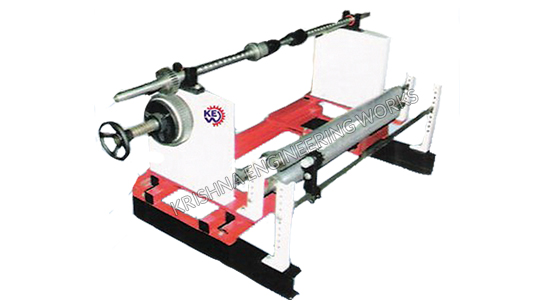
Rewinder Unwinder Manufacturer and Exporter
A rewinder unwinder is the pair of units at the two ends of a web line: the unwinder pays the parent reel out at controlled tension, and the rewinder winds the processed web into a finished reel. Krishna Engineering Works builds rewinder unwinder units as separate modules for printing, lamination, coating, slitting, extrusion, textile and tyre cord machines.
The units are manufactured in Ahmedabad, India, and built to the customer’s line data. This page explains what each unit contains, the equipment it is available with, and what to decide before ordering.
What is a rewinder unwinder?
A rewinder unwinder is a reel handling module, not a process machine. The process, whether printing, coating or laminating, happens between the two units. Their job is to feed the web in and take it out without changing its tension, its edge position or its surface.
Buyers order them separately for three reasons:
- An existing line needs a larger reel, a heavier reel or a faster reel change than its original stands allow.
- A line built in house or by another maker needs unwind and rewind stations.
- A second unwind is added, for example to feed another web into a laminator.
Krishna Engineering Works makes the unwinding machine or rewinder unit to suit all types of machines. Those it names are:
- Rotogravure printing machine
- Lamination machine
- Coating machine
- Slitting rewinding machine
- Extruder machine
- Textile machine
- Tyre machine
Equipment available with the KEW rewinder unwinder
The rewinder unwinder is available with the equipment below, as listed by Krishna Engineering Works. Each item is chosen for the line.
| Equipment | Its job on the unit | Catalogue page |
| Web aligner system | Moves the stand sideways to keep the web edge on line | Web aligner system |
| Mechanical or pneumatic brake | Holds back the unwinding reel to create tension | Pneumatic brake and powder brake |
| Tension control system | Adjusts the brake or drive as the reel diameter changes | Tension control |
| Line guide system | Guides from a printed line where the edge is not a true reference | Web guiding system |
| Rollers | Carry and turn the web between reel and machine | Industrial roller |
| Safety chucks | Support and lock the ends of the reel shaft | Safety chucks |
| Bow roller | Spreads the web to remove wrinkles before winding | Bow roll |
| Unwinder drive and control panel (optional) | Drives the unwind for webs that a brake alone cannot control | Built with the unit |
| Shaftless unwinder unit | Holds the reel by its core ends, with no through shaft | Built with the unit |
Because the aligner, brakes, rollers and chucks are KEW’s own products, the unit comes from one source and its spares do too.
How does the unwinder work?
The unwinder holds the parent reel, lets it turn against a controlled resistance and keeps its edge in line. Three functions decide how well it does this.
Holding the reel
On a shafted unwinder the reel is carried on a shaft that drops into safety chucks at each side. The chucks support the shaft, transmit the brake torque and lock so the shaft cannot lift out. The shaft itself is usually an air shaft, which grips the core when inflated.
On a shaftless unwinder unit, two cones or chucks enter the core from each side and no shaft passes through the reel. This removes the handling of a heavy shaft, which matters most on wide and heavy reels.
Creating tension
Tension is created by resisting the pull of the line. A mechanical brake is set by hand. A pneumatic brake is set by air pressure, so it can be adjusted by a controller while the machine runs.
The difficulty is that a reel gets smaller as it unwinds. With a constant brake torque, web tension rises as the diameter falls, and it can double or more between full reel and core. A tension control system corrects this. It either follows the reel diameter or measures the tension directly with a load cell under a roller, and reduces the brake to keep the tension constant. KEW supplies load cells for this.
Keeping the edge in line
Parent reels are seldom wound with a perfectly straight edge. The web aligner system senses the edge just after the unwinder and shifts the whole stand sideways to cancel the error. Where the web is printed and the edge is not reliable, a line guide system follows a printed line.
How does the rewinder work?
The rewinder turns the core with a driven shaft and builds the reel layer on layer at a tension that suits the material. Its three concerns are drive, spreading and edge quality.
The drive must slow down as the reel grows, because the web speed stays constant while the diameter increases. It must also let the tension fall slightly towards the outside of the reel, so the outer layers do not crush the inner ones. In general practice this is called taper tension.
A bow roller ahead of the rewind spreads the web outward from the centre so it lays on the reel without creases. On a rewinder, the web aligner works the other way round from the unwinder: the rewind stand follows the incoming web, so every layer lands on the one below and the reel face is straight.
Rewinder unwinder units for labels
KEW also describes rewinders and unwinders for label and continuous label materials. These units process label rolls with large outer diameters at high speed, and are suited to both inside and outside winding of the label material.
Winding direction matters for labels because the applicator or printer that uses the reel needs the labels to face one way. A unit that winds in either direction lets one machine prepare reels for both. The units are described as user friendly and multi functional for different roll forms.
For reel to reel work on finished reels, such as correction, coding and inspection, KEW builds complete machines: the doctoring rewinding machine and the inspection rewinding machine. The group’s site on rewinding machines sets out the differences.
Which unwinder and rewinder arrangement suits your line?
Choose the arrangement from the reel weight, the material and how often reels are changed. The table gives the general logic used across the converting industry.
| Decision | Option | When it is the usual choice |
| Reel holding | Shaft with safety chucks | Light to medium reels, mixed core sizes |
| Reel holding | Shaftless unwinder unit | Wide or heavy reels, frequent changes |
| Unwind tension | Mechanical brake | Steady, forgiving materials and simple lines |
| Unwind tension | Pneumatic brake with tension control | Films and other materials that need constant tension |
| Unwind tension | Unwinder drive and control panel | Very light tension, or lines that must accelerate a heavy reel |
| Guiding reference | Web edge, by web aligner system | Plain webs and webs with a clean edge |
| Guiding reference | Printed line, by line guide system | Printed webs where the print must stay on line |
| Wrinkle control | Bow roller before the rewind | Thin films and wide webs |
A driven unwinder is worth its cost when a brake cannot go low enough. A brake can only resist. At very low tensions, or when a heavy reel must be accelerated without jerking the web, a drive that can both help and hold the reel gives better control.
How is a rewinder unwinder matched to an existing machine?
A rewinder unwinder is matched by taking the line data first and the mounting details second. The usual sequence is:
- Record the web width, the maximum reel diameter and the maximum reel weight.
- Record the core inside diameter and whether cores are paper, plastic or steel.
- Give the line speed and the tension range the process needs, or the materials and thickness so it can be worked out.
- Measure the centre height of the web path and the floor space at each end of the line.
- Say how the reel is brought to the machine: crane, trolley or lift table.
- Choose guiding by edge or by printed line.
- Agree how the unit takes its speed reference from the main machine drive.
On an extrusion line the rewinder runs continuously, since the extruder cannot stop for a reel change. Say so in the enquiry. The same applies to in line printing, described on the rotogravure or flexo on extruder page.
| Symptom at the unwind or rewind | Likely cause | First check |
| Tension rises as the reel empties | Brake torque not reduced with diameter | Tension control setting or sensor |
| Web snatches at start | Brake set for full reel inertia, or reel out of round | Brake setting, reel condition |
| Reel face stepped at the rewind | Rewind guide off, or sensor not on the stand | Sensor mounting and position |
| Creases wound into the reel | No spreading before the rewind | Bow roller position and wrap |
| Shaft lifts or rattles | Chuck not locked, or worn insert | Safety chuck closure and wear |
Trial, installation and service
Krishna Engineering Works inspects its components from raw material to final assembly and takes a trial before dispatch. Engineers travel to the customer’s site for installation and commissioning, and operator training and spare parts supply follow.
Brake linings, chuck inserts, shaft bladders and roller coverings are the usual wear parts. See repairing and servicing for the scope, or the products page for the machines these units serve.
What to send for a rewinder unwinder quotation
The unit is built to the data of your line. Send:
- The machine it will serve, and whether you need an unwinder, a rewinder or both
- Material and thickness or GSM range
- Web width, maximum reel diameter and maximum reel weight
- Core inside diameter and core material
- Line speed and tension range, if known
- Shafted or shaftless, braked or driven
- Guiding by edge or by printed line
- A sketch of the web path with the centre height, and the power supply
Send these through the contact page, and KEW will propose the unit.
Frequently Asked Questions
On a rewinder unwinder, which station holds back the web and which pulls it?
An unwinder holds the parent reel and pays the web out against a brake or drive, so the web enters the machine at steady tension. A rewinder turns a core with a driven shaft and winds the processed web into a finished reel. The unwinder controls tension by holding back, the rewinder by pulling.
Which machines can a KEW rewinder unwinder be fitted to?
Krishna Engineering Works makes the unwinding machine or rewinder unit to suit all types of machines. Those named are rotogravure printing machines, lamination machines, coating machines, slitting rewinding machines, extruder machines, textile machines and tyre machines. Each unit is built to the web width, reel size and speed of the line it joins.
What equipment is the rewinder unwinder available with?
The rewinder unwinder is available with a web aligner system, a mechanical or pneumatic brake, a tension control system, a line guide system, rollers, safety chucks and a bow roller. An unwinder drive with control panel is optional, and a shaftless unwinder unit is offered. The combination is selected from the material, reel weight and line speed.
Does a shaftless unwinder need a shaft through the core?
No, a shaftless unwinder holds the reel by its core ends, using a chuck or cone at each side. The operator does not have to insert and remove a heavy shaft at each reel change. It is generally chosen for wide and heavy reels and for lines with frequent changes.
Why does unwind tension change as the reel gets smaller?
Unwind tension changes because a brake applies torque, and the web pulls at the radius of the reel. As the radius falls, the same torque needs a larger pull, so tension rises. A tension control system reduces the brake torque in step with the reel diameter, or from a load cell reading, to keep tension constant.
Does KEW publish standard sizes for the rewinder unwinder?
No standard size table is published for the rewinder unwinder, because each unit is built to the customer’s line. Width, reel diameter, reel weight, core size and speed are taken from the machine it will serve. Send those figures with a sketch of the web path, and the unit is designed around them.
Can the unit wind labels facing in or out?
Yes, the label rewinders and unwinders are suited to both inside and outside winding of label material. The direction is chosen to suit the applicator or printer that will use the reel

