


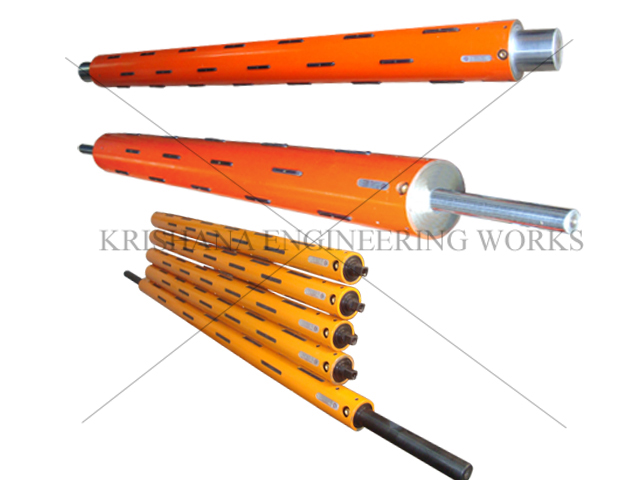
Air Shaft Manufacturer: Lug, Leaf, Multi-Tube, Differential and Mechanical Shafts
An air shaft is a winding shaft that expands when compressed air is let into it, so that it grips the inside of a core, and contracts when the air is released, so the reel slides off. Krishna Engineering Works manufactures the air shaft in ten designs, from lug and leaf shafts to differential and mechanical shafts, for core IDs from 2 inch to 12 inch and lengths to 6000 mm.
The shafts are made in Ahmedabad, India, for slitter rewinders, printing machines and other converting machinery. This page explains each type, gives the stated figures and shows how to choose.
What is an air shaft and how does it work?
An air shaft is a hollow steel or aluminium body with gripping elements that are pushed outward by an inflated rubber bladder. When the operator connects an air gun to the valve, the bladder fills, the lugs or leaves rise above the shaft surface and lock into the core. Pressing the valve releases the air, the elements drop back and the core is free.
Compared with a plain shaft and cone chucks, an air shaft centres the core along its whole length, changes over in seconds and does not crush the core ends. In a roll slitting section, where reels are changed many times per shift, that time is the main saving.
The working parts are few:
- Body. A slotted pipe that carries the load.
- Journals. The ends that sit in bearings or safety chucks, made to suit the user’s machine.
- Gripping elements. Lugs, leaves, strips or balls that touch the core.
- Bladder or tubes. The rubber element that expands under air.
- Non-return valve. Holds the air in while the shaft runs.
Air shaft types made by Krishna Engineering Works
Krishna Engineering Works makes ten shaft designs. The table summarises them, and the sections below give the details the company publishes for each.
| Shaft type | How it grips | Best suited to |
| Lug shaft | Lugs raised by a pneumatic bladder | General unwinding and rewinding |
| Leaf type air expandable shaft | Long leaves give full support to the core | Narrow and thin cores at the rewind |
| Multi-tube shaft | Several rubber tubes expand along the body | Unwinding and winding, cores above 150 mm wide |
| Multi bladder shaft | Several bladders in a light aluminium body | High torque with easy handling |
| Differential shaft | Each core slips independently on the shaft | Duplex winding of many slit reels |
| Ball shaft | Ball locks grip each core with controlled slip | Slitter rewinders with sensitive materials |
| Quick lock shaft | Individual locks positioned along the shaft | Economical rewinding on paper cores |
| Mechanical shaft (bladder-less) | Lugs moved by a cam, with no air | Heavy loads, uneven core IDs |
| Mechanical expanding shaft | External lugs on a wedge design | Heavy, firmly clamped reels |
| Bottom knife holding shaft | Multi bladder grip on knife rings | Holding bottom knives for slitting |
Lug shaft
The lug shaft is the most commonly used air shaft. It has a slotted metal pipe, lugs, a rubber bladder and a non-return valve, with journals to suit the machine. It is available in heavy duty and light duty configurations, holds the core well and has a long service life. Sizes suit core IDs of 3, 4, 6 and 8 inch, and metric and special sizes are also produced.
Leaf type air expandable shaft
The leaf shaft has a slotted base pipe and metal leaves with a knurled or serrated face, raised by a rubber bladder. Because the leaves run along the shaft, the core is supported over its full inside surface. This suits narrow core widths and prevents damage to thin cores. It can be used at the unwind but works best at the rewind stage, and in some applications it allows winding without a core.
Multi-tube shaft
The multi-tube shaft is a slotted pipe with journals and separate rubber tubes. It is used for both unwinding and winding and handles single or multiple cores above 150 mm wide. If one tube fails, the others still hold the core until the process is complete, and a damaged tube can be changed easily, even on the machine. The expanding area runs along almost the whole body.
Multi bladder shaft
The multi bladder shaft is made of lightweight aluminium with steel journals. It is easy to maintain and suitable for high torque. The light body matters on long shafts that are lifted by hand.
Differential shaft
The differential shaft is designed for duplex winding with many cores on one shaft. It compensates for gauge variation across the slit strips by letting each core turn at its own speed, and reels can be locked at any point along the shaft, so no spacers are needed between cores. Krishna Engineering Works states these figures for it:
- Minimum core width: 20 mm
- Speed: up to 1000 m/min
- Load capacity: up to 2 tons
- Core IDs: 3, 4, 6 and 8 inch, and custom sizes
- Core materials: paper, steel, thermoplastics
Ball shaft
The ball shaft is designed for slitter rewinders that handle many slit reels. Its ball locks allow different slippage speeds under constant tension, which suits sensitive materials. The minimum ball lock width is 24 mm.
Quick lock shaft
The quick lock shaft is a cost effective rewinder shaft for paper cores. Individual quick locks are placed along the shaft and allow quick repositioning of cores. It suits core IDs of 3, 4 and 6 inch, and the quick locks are available 50 mm, 75 mm, 100 mm and 300 mm wide.
Mechanical shaft (bladder-less shaft)
The mechanical shaft is a lug type shaft that grips mechanically instead of pneumatically. It consists of a slotted pipe, steel lugs, a brass cam and a ratchet. The cam and lug design gives a strong, positive grip and centres the core, which is an advantage with cores of uneven inside diameter. It is well suited to heavy loads and high speed, needs little maintenance and is available for several core sizes.
Mechanical expanding shaft
The mechanical expanding shaft has external lugs on a wedge design that holds cores concentric and parallel. The clamping force is high, so the reel stays firmly in place.
Bottom knife holding shaft
The bottom knife holding shaft uses a multi bladder design with close tolerances to hold the bottom knives of a shear slitting section. The body is alloy steel with a hardened chrome surface finish, for precision slitting.
How do you choose the right air shaft?
Choose the shaft from the core and the duty: the core’s inside diameter, width, material and wall thickness, then the reel weight, speed and position on the machine. The steps below lead to one of the types above.
- Measure the core inside diameter and its tolerance. Cores with uneven IDs favour a mechanical shaft or a leaf shaft.
- Note the core material: paper, steel or thermoplastic. Thin paper cores need full support.
- Note the narrowest core width. Very narrow cores need leaf, differential or ball designs.
- Decide whether all cores on the shaft must turn together or may slip. Slit reels of varying thickness need a differential or ball shaft.
- Add up the reel weight on the shaft and the running speed.
- Decide the position: unwind, rewind, or both.
- Record the journal details so the shaft fits the existing bearings or safety chucks.
| Your situation | Shaft to consider |
| One wide reel at the unwind | Lug shaft or multi-tube shaft |
| Thin walled or narrow cores at the rewind | Leaf type shaft |
| Many slit reels on one rewind shaft, thickness varies | Differential shaft or ball shaft |
| Paper cores, budget rewinder | Quick lock shaft |
| Heavy reels, cores with uneven ID | Mechanical shaft |
| Long shaft handled by hand | Multi bladder shaft with aluminium body |
| Holding bottom knives | Bottom knife holding shaft |
The mechanical and duplex winder shafts are described further on the expandable shaft page. The group’s specialist site on air shafts and chucks compares the designs in more depth.
Sizes, capabilities and materials
Krishna Engineering Works makes shafts for core IDs from 2 inch to 12 inch and in lengths to 6000 mm, and custom sizes are available. The table collects the figures the company publishes.
| Item | Stated figure |
| Core inside diameter range | 2 to 12 inch, metric and special sizes also produced |
| Length | To 6000 mm, as required |
| Load (differential and expandable shafts) | Up to 2 tons |
| Speed | Up to 1000 metres per minute |
| Minimum core width | 20 mm |
| Suitable core materials | Paper, steel, thermoplastics |
| Pipe | Steel (aluminium on the multi bladder shaft) |
| Journals | Steel, plain or hardened |
| Cam (mechanical shaft) | Brass |
| Lugs | Hardened steel or rubber |
Custom design and CNC machining are offered, so journals, lengths and lug patterns can follow the drawing of the machine.
Where air shafts are used
Air shafts are used at every unwind and rewind in converting: slitter rewinders, printing machines, laminators, coaters and winders. On KEW’s own slitter rewinder machine the rewind uses core locks for differential slip, and air shafts are an option on the winding rewinding machine at both unwinder and rewinder. They are also fitted to rewinder and unwinder units supplied for other lines.
Two neighbouring parts complete the station. Safety chucks carry the square ends of the shaft and let it be lifted out without tools. A pneumatic brake or powder brake on the chuck controls unwind tension. The cores themselves are cut to length on a core cutter machine.
Care and common faults
An air shaft needs clean, dry air and an occasional leak check. Most failures are slow leaks that let the core slip late in the reel.
| Symptom | Likely cause | First check |
| Core slips during the run | Slow air leak, or pressure too low at filling | Valve and bladder, with soapy water |
| Shaft will not deflate fully | Valve stuck or lugs jammed by dust | Clean the valve and the lug slots |
| One section does not grip | Tube or bladder section punctured | Replace that tube or bladder |
| Core hard to remove | Lugs not retracting, burrs in the core | Lug springs, core ends |
| Vibration at speed | Bent shaft or worn journals | Run out and journal fit |
General good practice: inflate to the pressure the maker specifies, never inflate a shaft without a core on it, keep paper dust out of the slots, and release the air before lifting the shaft.
Krishna Engineering Works supplies spares and accessories from stock: valves, hoses, clamps, lugs, inflator guns, rubber tubes and continuous rubber lugs. The rubber tube is part of the company’s rubber roller range. For repair work, see repairing and servicing, and for the whole catalogue the products page.
What to send for an air shaft quotation
An air shaft is made to fit your machine and your cores. Send:
- Shaft type, or the application so KEW can suggest one
- Core inside diameter, core material and wall thickness
- Narrowest and widest core width, and the number of cores per shaft
- Maximum reel weight and reel diameter
- Running speed
- Shaft overall length, face length and journal drawing, or the old shaft’s dimensions
- Position: unwind or rewind, and how the shaft is driven or braked
- Quantity, and any spares needed with it
Send these through the contact page.
Frequently Asked Questions
What does an air shaft do on a slitter rewinder?
An air shaft is used to hold cores during winding and unwinding on slitter rewinders and other converting machinery. It expands under air pressure to grip the inside of the core and contracts when the air is released. This gives a positive core hold at speed and lets reels be changed quickly without tools.
Which types of air shafts does Krishna Engineering Works manufacture?
Krishna Engineering Works manufactures differential shafts, mechanical shafts, quick lock shafts, leaf type shafts, lug shafts, multi-tube shafts, ball shafts, mechanical expanding shafts, bottom knife holding shafts and multi bladder shafts. Journals are made to suit the user’s machine, and metric and special sizes are produced as well as inch sizes.
What core sizes can KEW air shafts take?
KEW air shafts are available for core inside diameters from 2 inch to 12 inch and in lengths to 6000 mm, with custom sizes on request. The common lug shaft sizes are for 3, 4, 6 and 8 inch cores. Quick lock shafts suit 3, 4 and 6 inch paper cores.
Which air shaft type is gentler on thin cores, lug or leaf?
The leaf type is gentler on thin cores, because its long leaves support the core along its full length, while a lug shaft grips at separate points for general duty. It also holds narrow cores better, so it is preferred at the rewind.
When is a differential shaft needed?
A differential shaft is needed when several slit reels are wound on one shaft and the strips differ slightly in thickness. Each core is allowed to slip at its own rate, so every reel is wound at the right tension and none goes slack. KEW states a minimum core width of 20 mm for its differential shaft.
What is a mechanical or bladder-less shaft?
A mechanical shaft grips the core with lugs that are moved by a cam and ratchet instead of by air. It has no bladder to puncture, gives a strong positive grip and centres the core even when the inside diameter is uneven. It is chosen for heavy loads and high speed and needs little maintenance.
Are spare parts for air shafts available?
Yes, Krishna Engineering Works supplies spare parts and accessories for air shafts from stock. The list includes valves, hoses, clamps, lugs, inflator guns, rubber tubes and continuous rubber lugs. When ordering, give the shaft type, core size and shaft length so the correct bladder or tube is supplied.

