


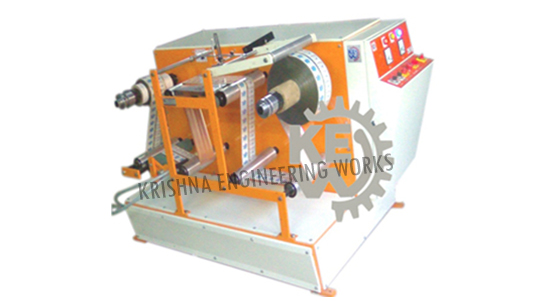
Doctoring Rewinding Machine Manufacturer and Exporter
A doctoring rewinding machine runs a finished reel from one shaft to another at controlled tension so the operator can stop at a defect, cut it out, splice the web and rewind a clean, straight reel. Krishna Engineering Works builds the doctoring rewinding machine in more than 25 models, for web widths from 100 mm to 1500 mm.
The machines are manufactured in Ahmedabad, India, and configured to the client’s reels and application. This page lists the models, the specification, the options and the way to choose between them.
What does a doctoring rewinding machine do?
A doctoring rewinding machine corrects reels that cannot go to the customer or to the packing line as they are. In converting, to doctor a reel means to open it up, remove what is wrong and close it again.
Krishna Engineering Works describes the machine as specially designed for correcting badly wound reels and for inspection and doctoring operations. With a printer fitted, it is also a substitute for online coding and batching. The typical jobs are:
- Reel correction. A telescoped, loose or stepped reel is rewound with straight edges and even hardness.
- Defect removal. Lengths with print faults, lamination faults, wrinkles or joins in the wrong place are cut out and the web is spliced.
- Reel sizing. A large reel is divided into smaller reels of a set length, or part reels are joined into one full reel.
- Winding direction change. A reel is rewound so the print faces in or out, as the packing machine needs.
- Offline coding. Batch numbers and dates are printed on the web while it is rewound.
Doing this work on a separate machine keeps the printing press, the laminator and the slitter running at full speed on good material.
How is the KEW doctoring rewinding machine built?
The KEW doctoring rewinding machine is a cantilever design with a movable unwind stage, a braked unwind and a driven rewind. The published description names these features.
- Cantilever design balancing body. Both shafts are supported at one end, so the parent reel and the rewound reel are loaded and unloaded from the open side without lifting a shaft out.
- Movable unwind stage for edge guiding. The unwind stage moves sideways under a hydraulic web aligner, so a parent reel with an uneven edge is rewound with a straight one.
- Optional magnetic powder brake. The unwind can be fitted with a magnetic powder brake with a tension controller and a torque control potentiometer in place of the mechanical brake.
- Provision for an inkjet printing system. The frame has provision for an inkjet printer with hot air ink drying.
The edge guide is KEW’s own web guiding system. A magnetic particle brake gives a torque that follows its coil current smoothly, which is why it is chosen for thin films and for frequent starts and stops. The brake types are compared on the pneumatic brake and powder brake page.
Doctoring rewinding machine models
More than 25 models are offered, and they differ in size, speed and the attachments they carry. The table groups the model names used by Krishna Engineering Works by the job each one does.
| Model | What sets it apart | Typical job |
| Standard doctoring rewinding machine | Unwind, rewind and edge guide | Correcting badly wound reels |
| Table top doctoring rewinding machine | Compact machine for small, light reels | Narrow reels and short lengths |
| High speed doctoring rewinding machine | Built for higher running speed | Large volumes of reel correction |
| Heavy duty doctoring rewinding machine | Built for heavier parent reels | Reels near the top of the weight range |
| Doctoring rewinding machine with slitting system | Slitting arrangement between unwind and rewind | Trimming edges or slitting while doctoring |
| Inspection doctoring slitting machine | Inspection, defect removal and slitting on one machine | Printed reels before dispatch |
| Label stock doctoring rewinding machine | Configured for label stock | Label reels |
| Winding rewinding machine with multihead inkjet printer | Carries more than one print head | Coding several lanes across the web |
| Winding rewinding machine with thermal transfer overprinter | Carries a thermal transfer printer | Dates and batch codes on film |
| Film strip and coil winding rewinding machine | For narrow strips and coils | Strip and coil rewinding |
| Doctor re-reeling machine | Rewinds reel to reel | Re-reeling to a new length or core |
| Special application doctoring rewinding machine | Built to the client’s requirement | Jobs outside the standard models |
The printer versions are described in full on the winding rewinding machine with inkjet printer page.
Technical specification of the doctoring rewinding machine
The table gives the specification of the doctoring rewinding machine as published by Krishna Engineering Works. Different models cover different unwind weights.
| Item | Specification |
| Web width | 100 mm to 1500 mm |
| Maximum weight of unwind | 100 kg to 1000 kg (different models for different weights) |
| Maximum parent reel diameter | 400 mm |
| Maximum rewind reel diameter | 400 mm |
| Rewind core diameter | 76 mm |
| Motor | 2 HP DC motor or 2 HP AC motor (3 HP and 5 HP also available on suitable models) |
| Maximum designed speed | 100 to 150 metres per minute |
| Body | Cantilever design balancing body |
| Edge guiding | Movable unwind stage with hydraulic web aligner |
| Unwind brake option | Magnetic powder brake with tension controller and torque control potentiometer |
| Printer provision | Inkjet printing system with hot air ink drying |
Options: slitting, inkjet and thermal transfer printing
The options turn a plain doctoring machine into a slitting, coding or inspection machine. Choose them from the work the machine must do.
Slitting system
A slitting system between the unwind and the rewind lets the operator trim a damaged edge, remove a faulty lane or slit the reel into two or more reels during doctoring. For slitting as the main job at higher speed, the slitter rewinder machine is the right machine.
Inkjet printer
An inkjet printer marks batch numbers, dates and codes on the moving web without touching it. Inkjet printing needs the web speed to be known, so the printer is timed from the web, and the ink is dried with hot air before the web reaches the rewind. Multihead versions print several lanes across the web.
Thermal transfer overprinter
A thermal transfer overprinter prints through a ribbon pressed against the film. Thermal transfer printing gives sharp, solid characters and small bar codes on smooth films. The group’s site on batch printing on reels compares the printer types.
Inspection
Where the main task is to find print defects, not to correct winding, the inspection rewinding machine handles larger reels, up to 1000 mm diameter, with illumination and stroboscopic equipment.
How do you choose a doctoring rewinding machine?
Choose the model from the heaviest reel, the widest web and the job to be done. The table shows the general logic.
| Your situation | Model to look at | Reason |
| Small reels, occasional correction | Table top | Small footprint, quick to load |
| Daily correction of production reels | Standard or high speed | Output matches a press or slitter |
| Parent reels near 1000 kg | Heavy duty | Unwind built for the weight |
| Edges damaged or lanes to remove | With slitting system | Cuts while doctoring |
| Reels need batch codes | With inkjet or thermal transfer printer | Codes offline, at rewinding speed |
| Printed reels checked before dispatch | Inspection doctoring slitting | Finds, removes and trims in one pass |
Thin and stretchy films are better served by the magnetic powder brake with its tension controller, because the tension is set and repeated by a control, not by hand. Separate tension control units are also available. For quick core changes, the shafts can be chosen from the air shaft range.
How is a reel doctored, step by step?
A reel is doctored by running it to the fault, removing the fault and splicing the web so the join runs cleanly at the customer. The general procedure is the same on every model.
- Load the faulty reel on the unwind shaft and an empty 76 mm core on the rewind shaft.
- Thread the web through the guide rolls and tape it squarely to the core.
- Set the unwind brake for the material and switch on the web aligner.
- Run the web and stop at the marked defect, flag or join.
- Cut out the faulty length across the web.
- Butt the two ends together in register with the print and join them with splicing tape.
- Mark the splice as the customer requires, then run on to the next fault.
- Finish the reel, tape the tail and unload from the open side of the shaft.
| Problem during doctoring | Likely cause | First check |
| Rewound reel edge is stepped | Web aligner off, or sensor away from the edge | Sensor position |
| Reel is soft or telescopes | Unwind tension too low | Brake setting |
| Film stretches or necks in | Unwind tension too high | Brake setting, powder brake control |
| Splice opens at the packing machine | Ends overlapped or tape too narrow | Splice method and tape |
| Wrinkles at the rewind | Web not square to the core at the start | Threading and tail taping |
The group’s site on the doctoring process covers splicing and reel correction methods in more detail.
Trial, installation and service
Each machine is given a continuous trial before dispatch, and the customer is invited to the factory to take a trial of the machine. Krishna Engineering Works supports installation and commissioning on site, trains operators and supplies spare parts to customers in India and abroad.
Brake parts, rubber rolls and shaft parts are the usual wear items. The repairing and servicing page gives the scope, and the full range of machines is on the products page.
What to send for a doctoring rewinding machine quotation
The model is chosen from your reel data and the work to be done. Send:
- Materials, with the thickness range of each
- Web width: narrowest and widest
- Parent reel: maximum diameter, weight and core size
- Rewound reel: maximum diameter and core size
- The job: reel correction, defect removal, slitting, coding or inspection
- Printer type wanted, if any, and what is to be printed
- Speed required and power supply
Send these through the contact page, and KEW will propose the model.
Frequently Asked Questions
What is a doctoring rewinding machine?
A doctoring rewinding machine is a reel to reel machine that unwinds a finished reel, lets the operator stop at a defect and remove it, and rewinds the web into a clean reel with straight edges. Converters use it to correct badly wound reels, cut out faulty lengths, resize reels and, with a printer fitted, to add batch codes.
What is the specification of the KEW doctoring rewinding machine?
The published specification gives a web width of 100 mm to 1500 mm, an unwind weight of 100 kg to 1000 kg depending on the model, a maximum parent and rewind reel diameter of 400 mm and a 76 mm rewind core. The motor is 2 HP DC or AC, with 3 HP and 5 HP available, and the designed speed is 100 to 150 metres per minute.
How many models of doctoring rewinding machine does KEW offer?
Krishna Engineering Works offers more than 25 models of doctoring rewinding machine. They include standard, table top, high speed and heavy duty machines, machines with a slitting system, machines with a multihead inkjet printer or a thermal transfer overprinter, label stock machines, film strip and coil winders, and special application machines built to the client’s requirement.
Which KEW machine removes known defects and which one finds them?
A doctoring machine is built mainly to correct reels and remove known defects, while an inspection machine is built to find defects in printed material. The KEW inspection rewinding machine has illumination and optional stroboscopic equipment and takes larger reels. Many converters combine both tasks on an inspection doctoring slitting machine.
Can a doctoring rewinding machine slit the reel as well?
Yes, the doctoring rewinding machine is offered with a slitting system. It trims damaged edges, removes a faulty lane or divides the reel while it is being doctored. For production slitting at higher speeds and larger reel diameters, a dedicated slitter rewinder is the better choice, since it is built around the knives and the rewind tension.
Why does the unwind stage move sideways?
The unwind stage moves sideways so that the web edge always reaches the rewind on the same line. A hydraulic web aligner senses the edge and shifts the stage to follow any unevenness in the parent reel. This is how a telescoped or stepped reel goes in and a reel with a straight face comes out.
Which brake is used on the unwind?
The standard unwind brake is mechanical, and a magnetic powder brake with a tension controller and a torque control potentiometer is offered as an option. The powder brake lets the operator set tension on a control and repeat it from reel to reel. It is the usual choice for thin films and for machines that stop and start often.

